What DQ decides — and what it does not
Separate a design decision from installation checks and process performance.
2.0 minutes · English captions · Illustrations and worked example
This lesson’s core explanations and worked-example reasoning are narrated. The table restates the example for reference; the practice activity and model answer are reading exercises.
English captions available.
Narration and visual explanations
Open View Technical Explanation to see each diagram, its text description and the matching narration. Standard abbreviations and numerals are used visually.
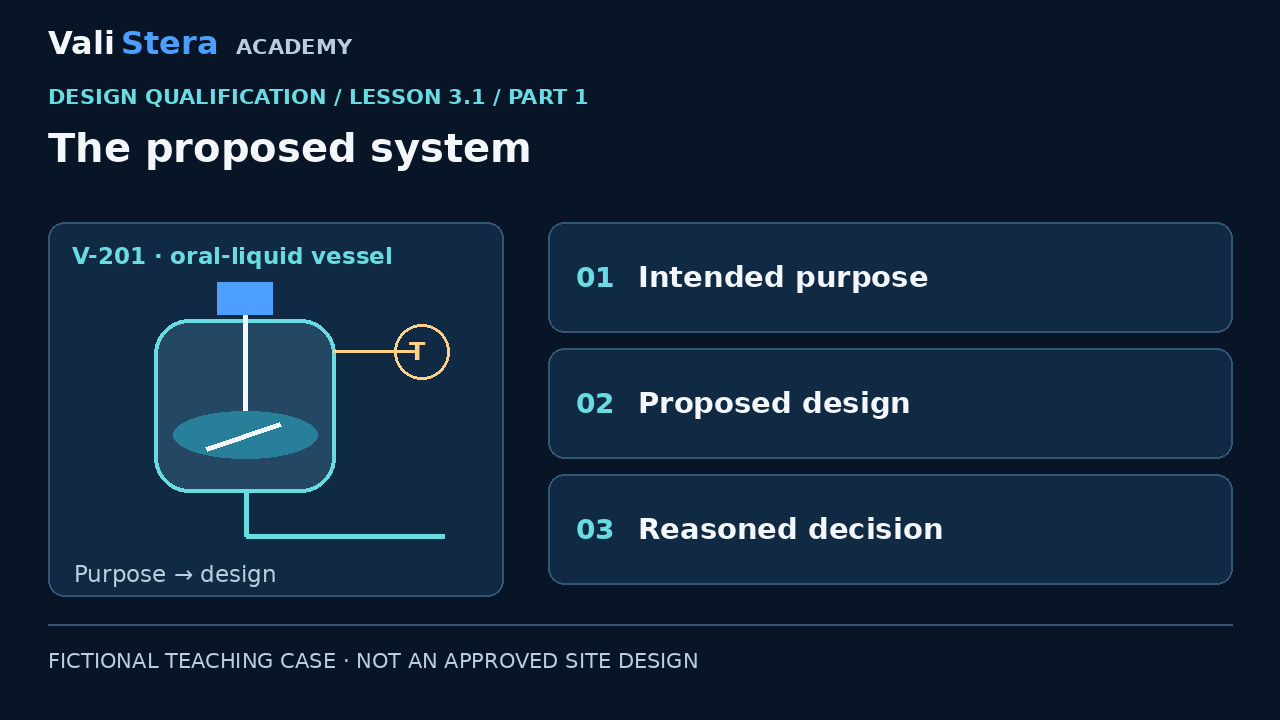
The proposed system
View Technical Explanation · Diagram 1
Lesson explanation
Welcome to Module 3: Design Qualification, or DQ. Our fictional vessel V-201 prepares an aqueous oral solution before filling. It is not an aseptic process. The diagram connects intended purpose to a proposed design and then to a reasoned decision. We ask whether the design can support the intended use. A purchase order or attractive equipment drawing cannot answer that question by itself.
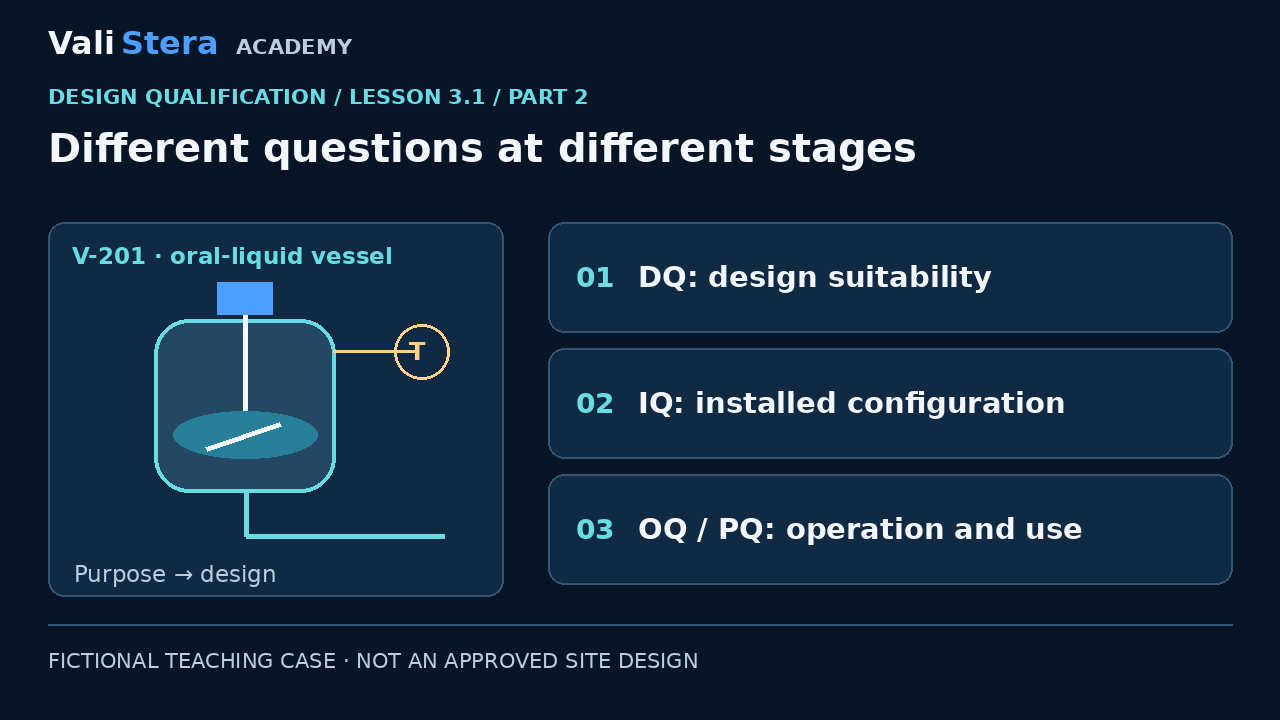
Different questions at different stages
View Technical Explanation · Diagram 2
Lesson explanation
DQ evaluates the proposed design. Installation qualification examines what was installed. Operational qualification challenges operation, and performance qualification addresses performance for the intended use under defined conditions. These questions are connected but not interchangeable. A successful design review does not demonstrate that the installed vessel mixes a real batch uniformly. Later modules examine those later stages. Keep the evidence and the decision appropriate to the stage.
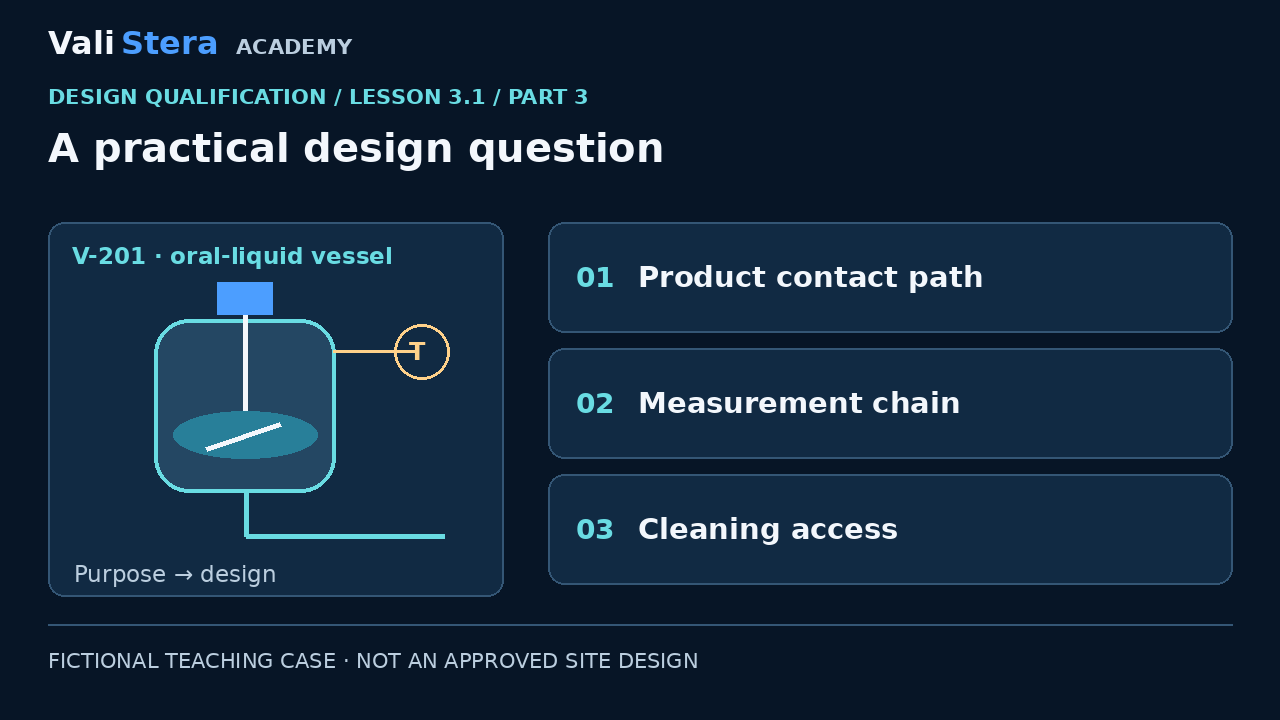
A practical design question
View Technical Explanation · Diagram 3
Lesson explanation
Look at three design concerns: the product contact path, the measurement chain and access for cleaning. A vessel can have a suitable steel body yet an unsuitable gasket. A temperature display can work while representing the wrong sensor location. A shiny exterior can conceal a trapped pocket. For each concern, ask which design feature addresses the need, what evidence supports that claim and what must later be verified.
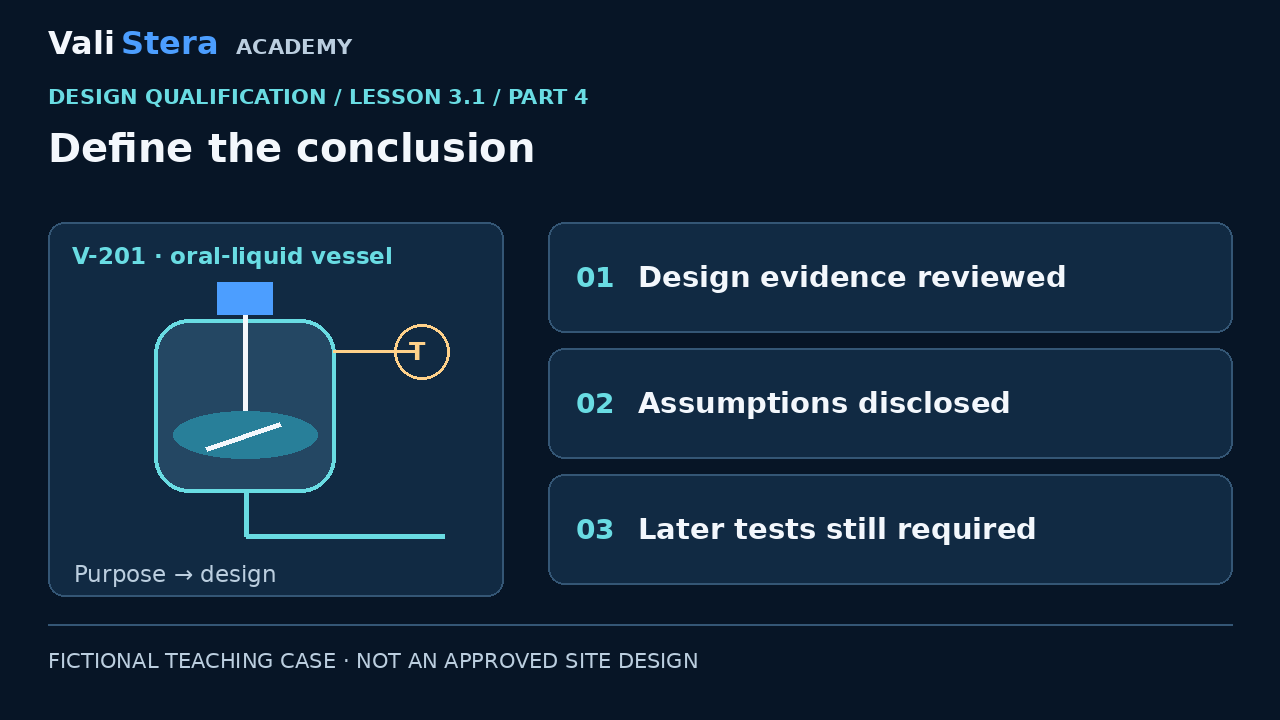
Define the conclusion
View Technical Explanation · Diagram 4
Lesson explanation
In this course, every equipment identifier, specification and evidence reference is a teaching invention. No site equipment has been qualified. At the end of a DQ review, state the design scope, the evidence examined and the open conditions. Do not write ready for routine production when only design evidence has been assessed. Your first activity is to distinguish a design conclusion from an installation finding and a performance claim.
Worked example
| Claim | Appropriate evidence |
|---|---|
| Design includes access for cleaning | Reviewed drawing and cleaning concept; suitability rationale |
| Installed access matches design | Installation inspection against approved drawing |
| Cleaning is effective | Approved cleaning-validation approach and executed results |
Apply it · Activity 1
Classify three statements: the drawing includes a drain; the installed drain matches the drawing; the defined cleaning cycle removes residues. Explain the evidence needed for each.
Open workbook activityCompare with model reasoning
Design review checks the proposed drain and its rationale. IQ checks installation against the approved design. Cleaning validation needs a justified study and executed evidence; a drawing does not prove cleaning effectiveness.