What installation qualification establishes
Distinguish installed configuration from operating performance.
1.9 minutes · English captions · Illustrations and worked example
This lesson’s core explanations and worked-example reasoning are narrated. The table restates the example for reference; the practice activity and model answer are reading exercises.
English captions available.
Narration and visual explanations
Open View Technical Explanation to see each diagram, its text description and the matching narration. Standard abbreviations and numerals are used visually.
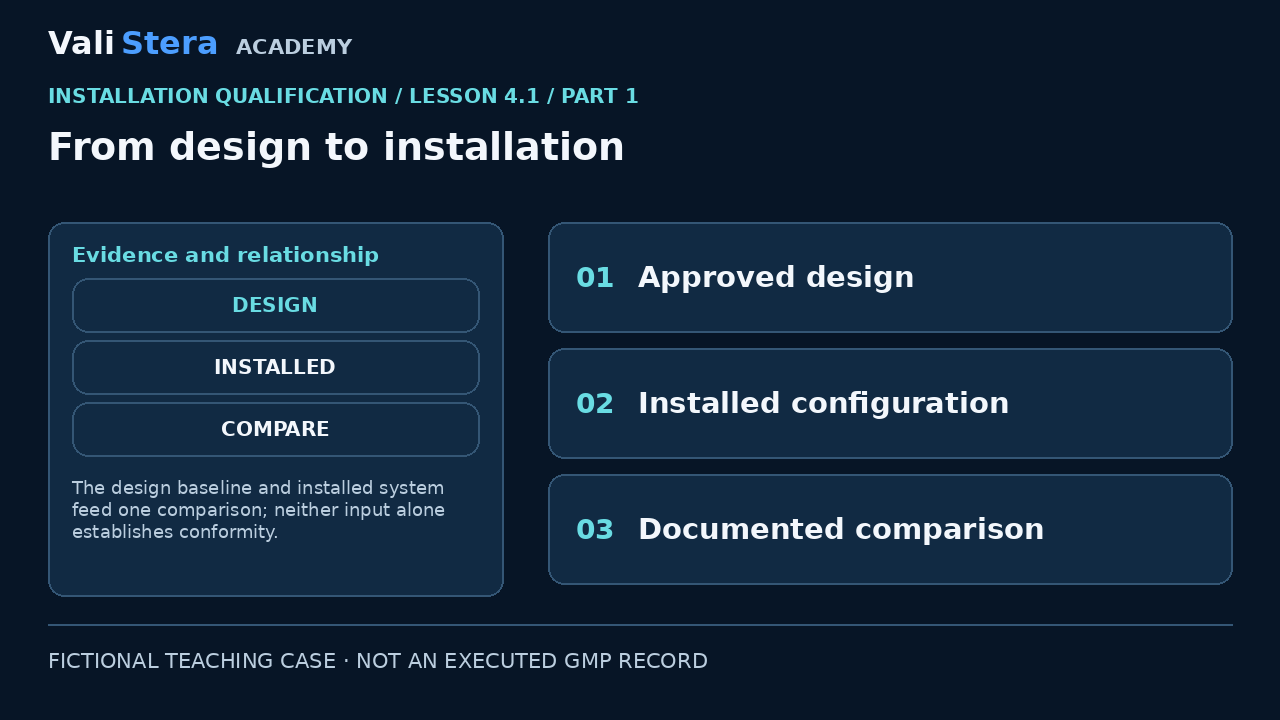
From design to installation
View Technical Explanation · Diagram 1
Lesson explanation
Welcome to Module 4, Installation Qualification, or IQ. We continue with the fictional V-201 oral-liquid mixing vessel. The design review described what was intended. Now the team compares the installed system with the accepted design and manufacturer recommendations. Every identifier and observation in this module is invented for training. No real equipment has been qualified.
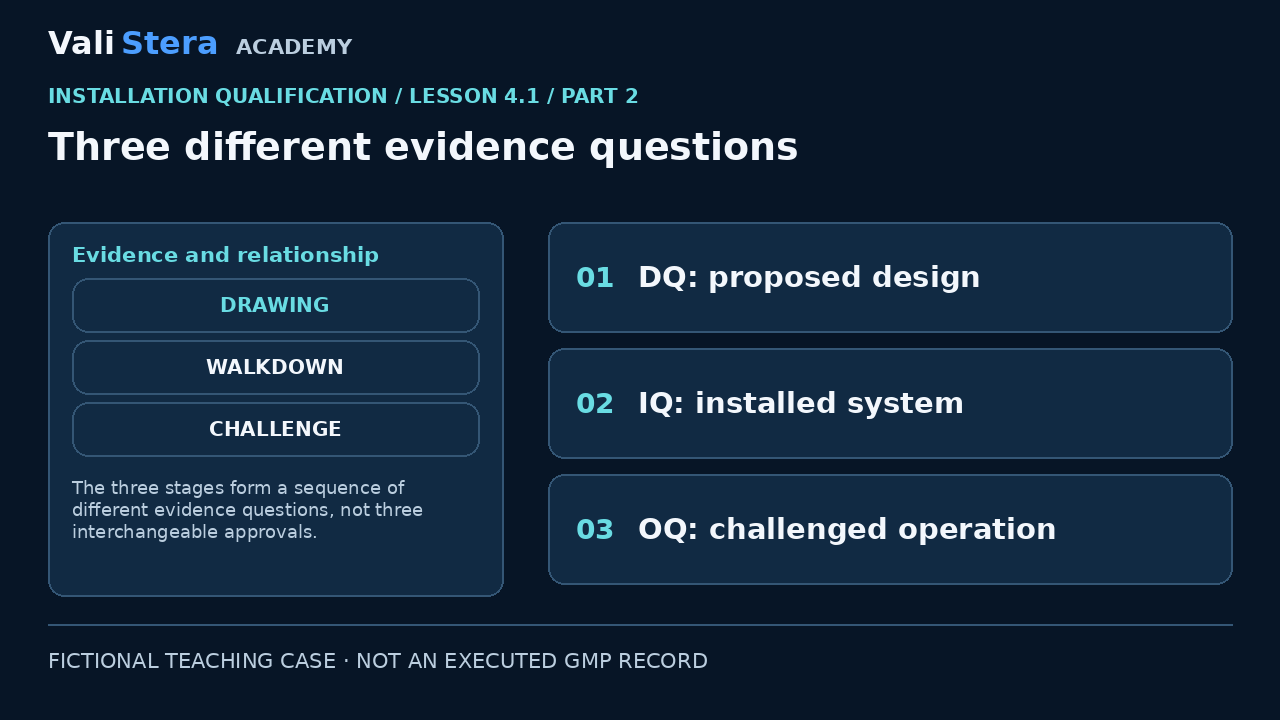
Three different evidence questions
View Technical Explanation · Diagram 2
Lesson explanation
A drawing shows a temperature sensor connection. A walkdown identifies which sensor is installed at that connection. An operational challenge examines how the assembled loop behaves. These answer different questions. Finding the correct tag does not demonstrate alarm response, and a successful alarm test does not repair missing material identification. Keep each conclusion tied to the evidence actually obtained.
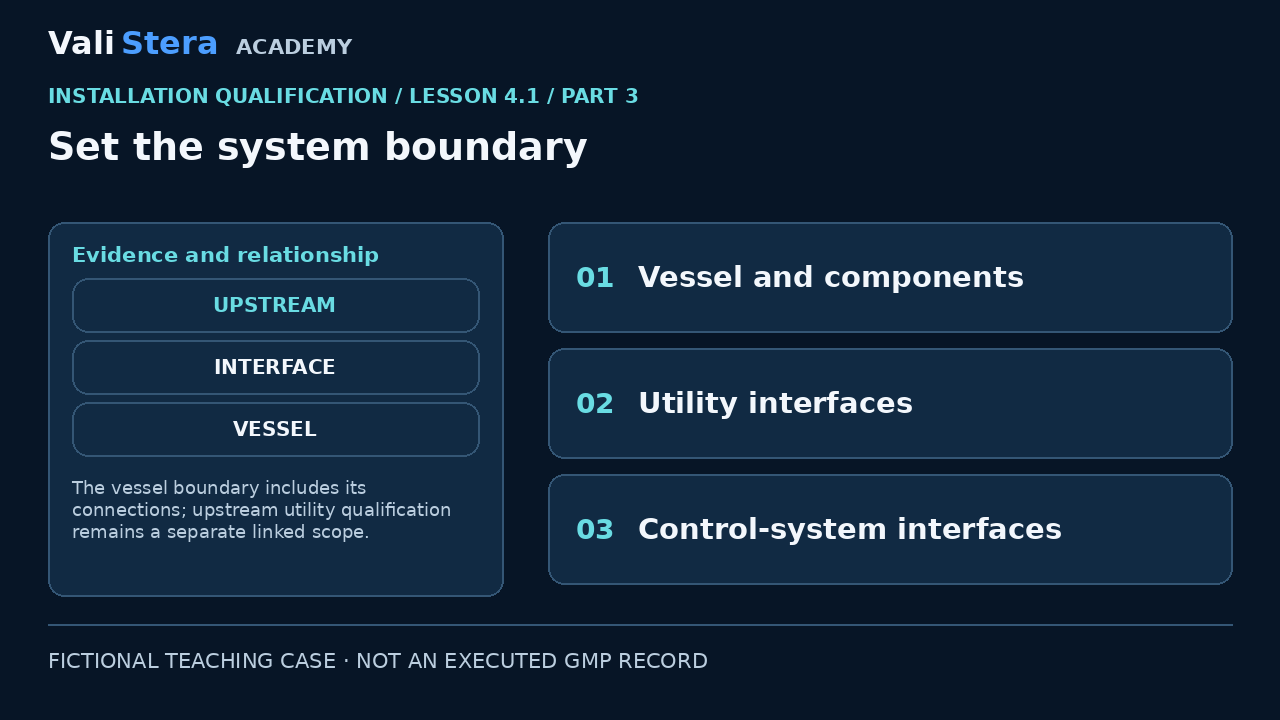
Set the system boundary
View Technical Explanation · Diagram 3
Lesson explanation
For our case, the installation boundary includes the vessel, agitator, outlet components, instruments and defined utility connections. The upstream utility plant has its own qualification scope. Record where one system ends and another begins. A qualified water system does not automatically prove that a new branch has the correct connection or that its delivered water is suitable.
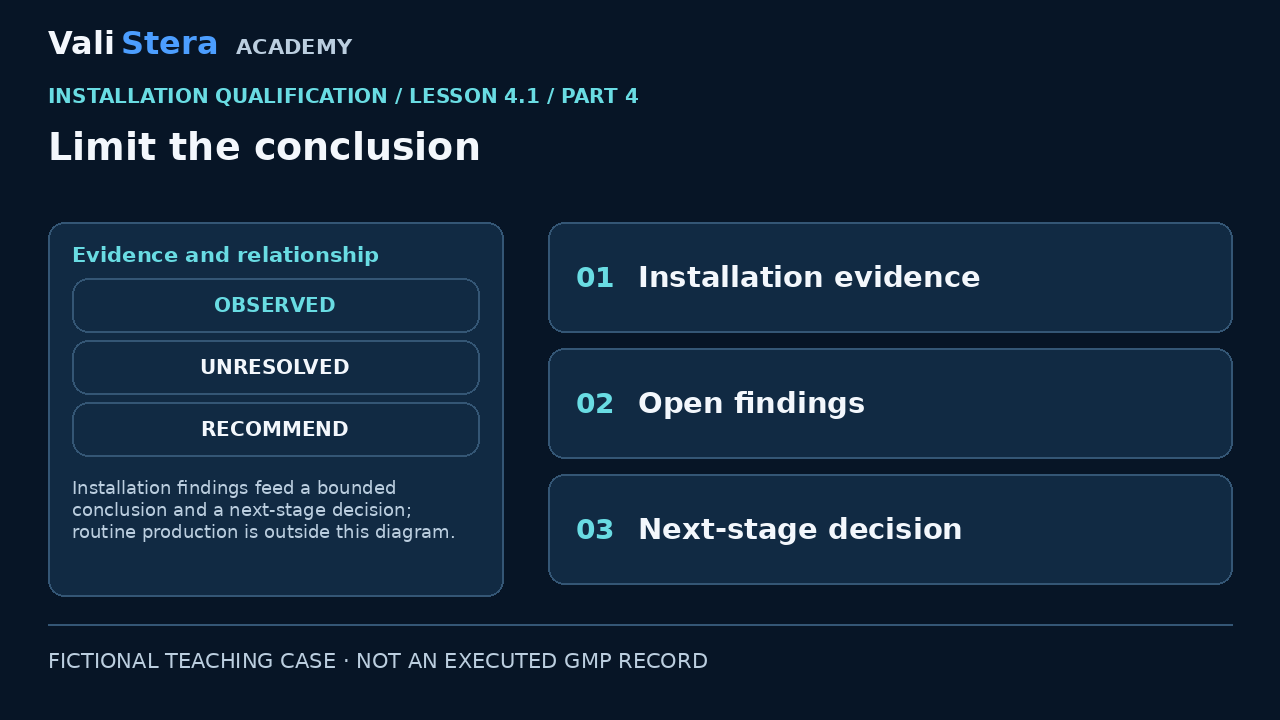
Limit the conclusion
View Technical Explanation · Diagram 4
Lesson explanation
The teaching conclusion is limited to installation evidence reviewed against the defined baseline. It is not permission to manufacture a batch. Operational and performance verification remain separate needs. Where stages are combined in an approved approach, the underlying evidence questions still remain visible. Your first activity separates installation observations from claims that require later studies.
Worked example
| Observation | Supported conclusion |
|---|---|
| Sensor serial matches schedule | Installed identity matches this baseline |
| Alarm challenge not executed | No alarm-performance conclusion |
| No product study | No blend-uniformity conclusion |
Apply it · Activity 1
Classify: sensor serial matches schedule; alarm stops heating; batch blend is uniform. Explain the evidence boundary.
Open workbook activityCompare with model reasoning
The first is installation identity evidence. Alarm response needs a defined operational challenge. Blend uniformity needs a justified performance/process study; neither is proven by identity alone.