Verify piping and utility interfaces
Check the installed connection while preserving upstream qualification boundaries.
1.8 minutes · English captions · Illustrations and worked example
This lesson’s core explanations and worked-example reasoning are narrated. The table restates the example for reference; the practice activity and model answer are reading exercises.
English captions available.
Narration and visual explanations
Open View Technical Explanation to see each diagram, its text description and the matching narration. Standard abbreviations and numerals are used visually.
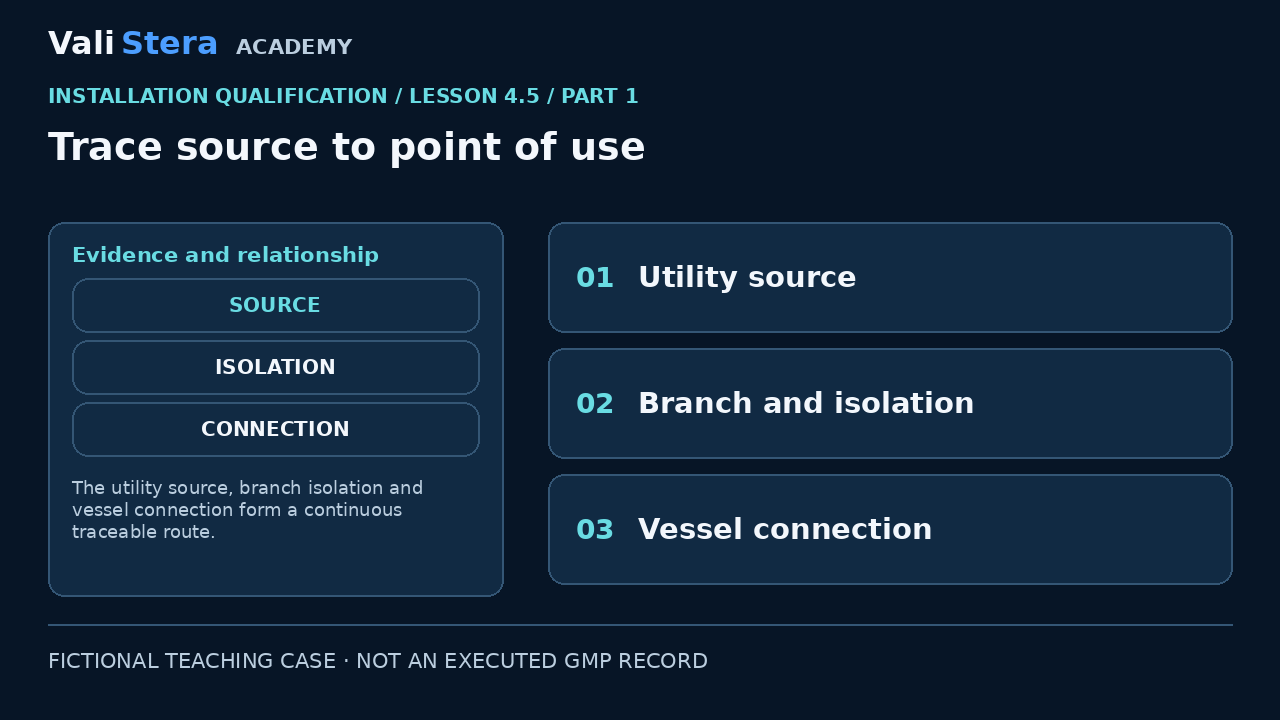
Trace source to point of use
View Technical Explanation · Diagram 1
Lesson explanation
Trace the installed branch from its defined source to the vessel connection against the controlled piping diagram. Check the specified route, isolation and identifiers using safe methods. Do not assume a pipe has the intended contents because its colour looks familiar. A label and the actual connection must agree with the system information.
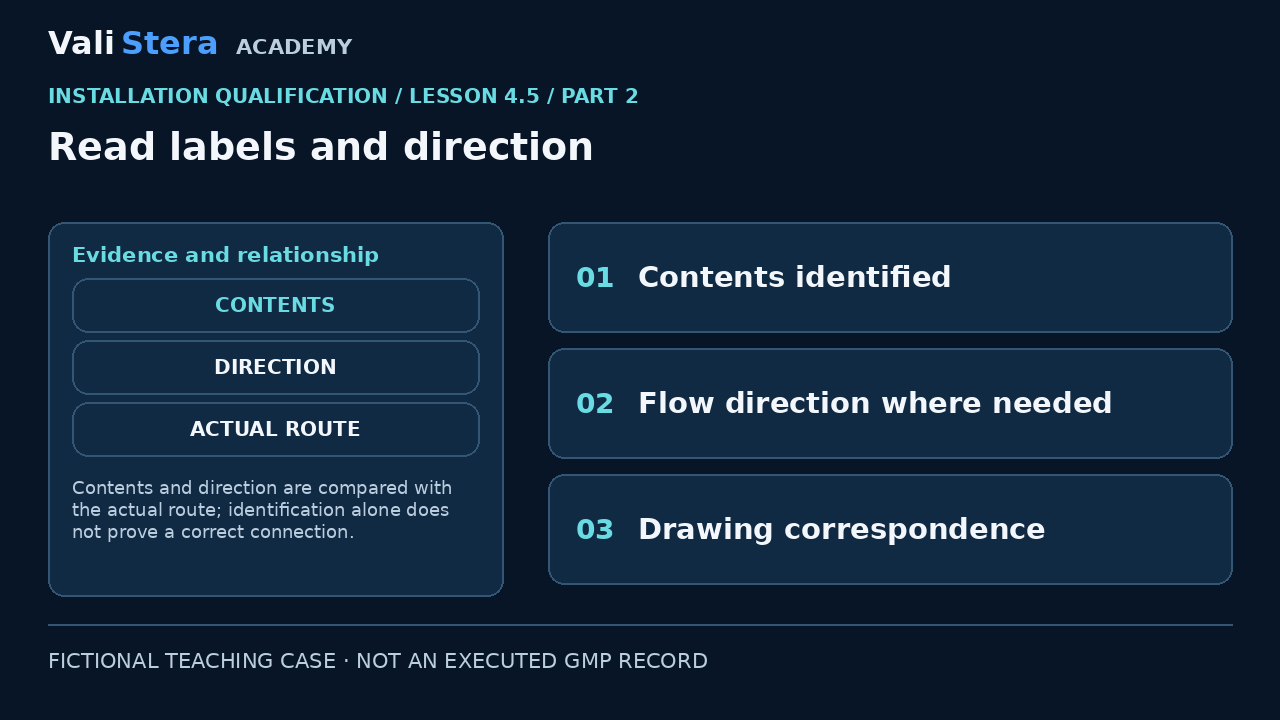
Read labels and direction
View Technical Explanation · Diagram 2
Lesson explanation
For fixed pipework, contents identification and applicable flow direction help prevent mistakes. Compare labels with the route and controlled drawing, including places where lines cross. A correct label on the wrong connected branch remains a discrepancy. Record the location so the engineering team can resolve the actual connection rather than merely replacing the label.
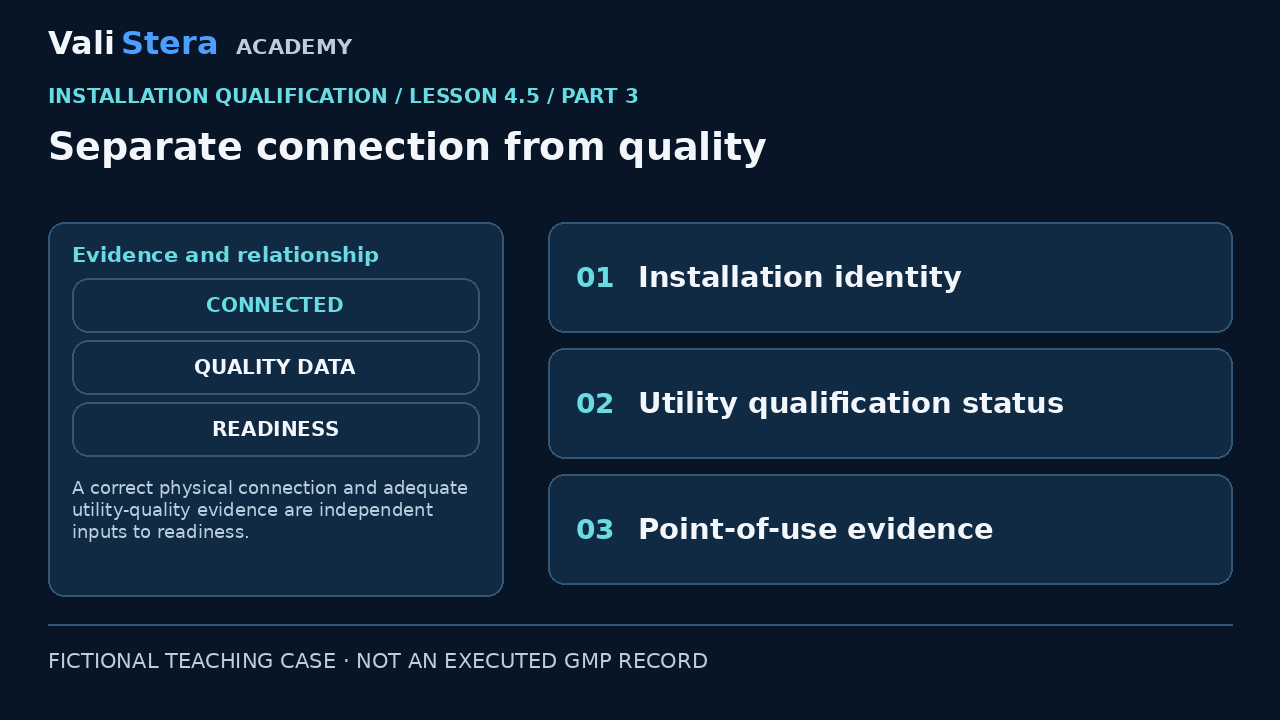
Separate connection from quality
View Technical Explanation · Diagram 3
Lesson explanation
The branch may be installed as drawn while the required utility-quality evidence is still unavailable. Record those as separate statuses. A pressure indication alone cannot establish chemical or microbiological suitability. Determine what qualification and sampling evidence applies to the intended use through the approved project approach, rather than borrowing limits from an unrelated sterile process.
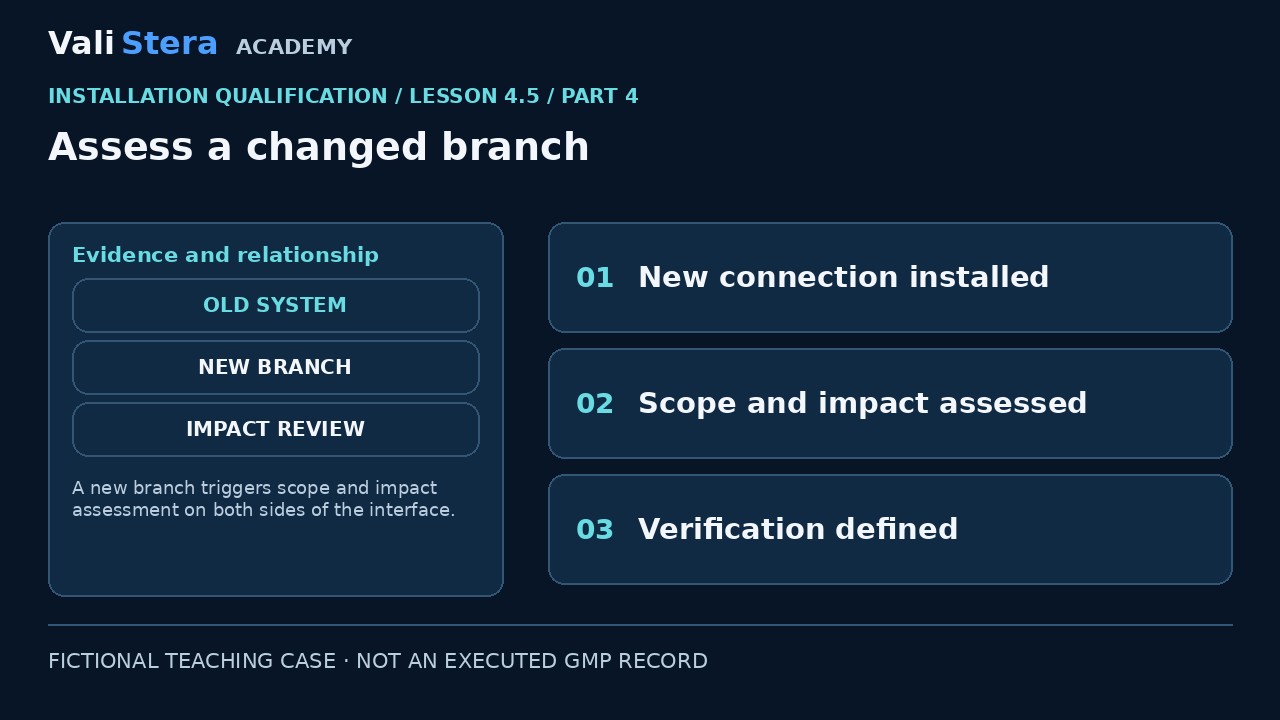
Assess a changed branch
View Technical Explanation · Diagram 4
Lesson explanation
A late branch addition may affect the upstream system as well as the receiving vessel. Identify the changed configuration and assess the required installation and other verification before use. Do not assume that the original utility qualification covers every future extension. Our workbook asks which records and responsible system owners must be linked before closing the interface.
Worked example
| Question | Evidence type |
|---|---|
| Correct branch connected? | Walkdown against controlled diagram |
| Utility suitable for use? | Applicable qualification and quality evidence |
| New branch covered? | Change impact and defined verification |
Apply it · Activity 5
List separate evidence for a correctly installed utility connection and suitable delivered utility quality.
Open workbook activityCompare with model reasoning
Installation evidence includes route, isolation, labels and drawing comparison. Quality evidence follows the approved utility qualification and relevant point-of-use requirements. Cross-reference both; neither substitutes for the other.