Plan before you qualify
Connect a manufacturing need to evidence and an authorized decision.
1.9 minutes · English captions · Transcript + illustrated learning notes
This lesson has no separate required companion-reading extension; study the diagram explanations and activity below.
English captions available in the video player.
Narration and visual explanations
This transcript represents the recorded lesson using conventional written abbreviations and numerals. Open View technical information to see each diagram and its explanation. This lesson has no separate required companion-reading extension; study the diagram explanations and activity below.
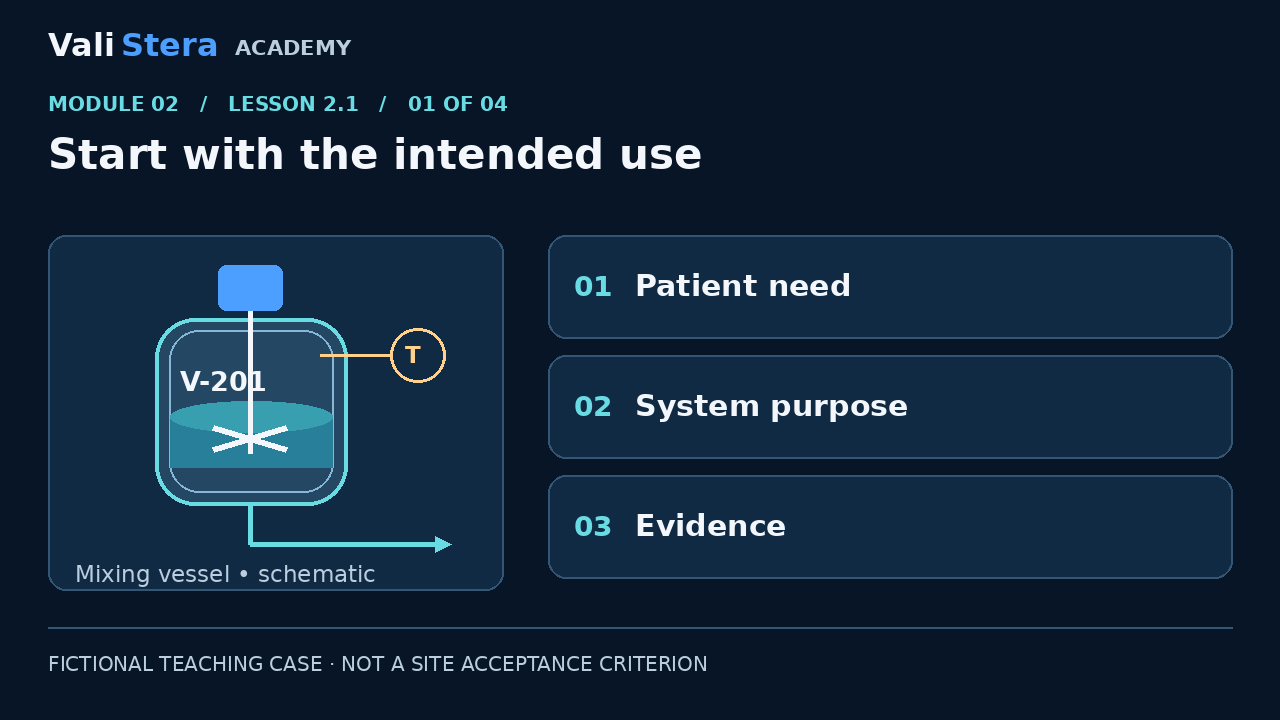
Start with the intended use
View technical information · Diagram 1
Lesson explanation
Welcome to Module 2. Our fictional project is a jacketed mixing vessel used to prepare an aqueous oral solution before filling. It is not an aseptic process. We will follow the project from planning to a review decision. Begin by asking what product the system supports, how it will be used, and what could go wrong. A polished protocol cannot rescue an undefined purpose.
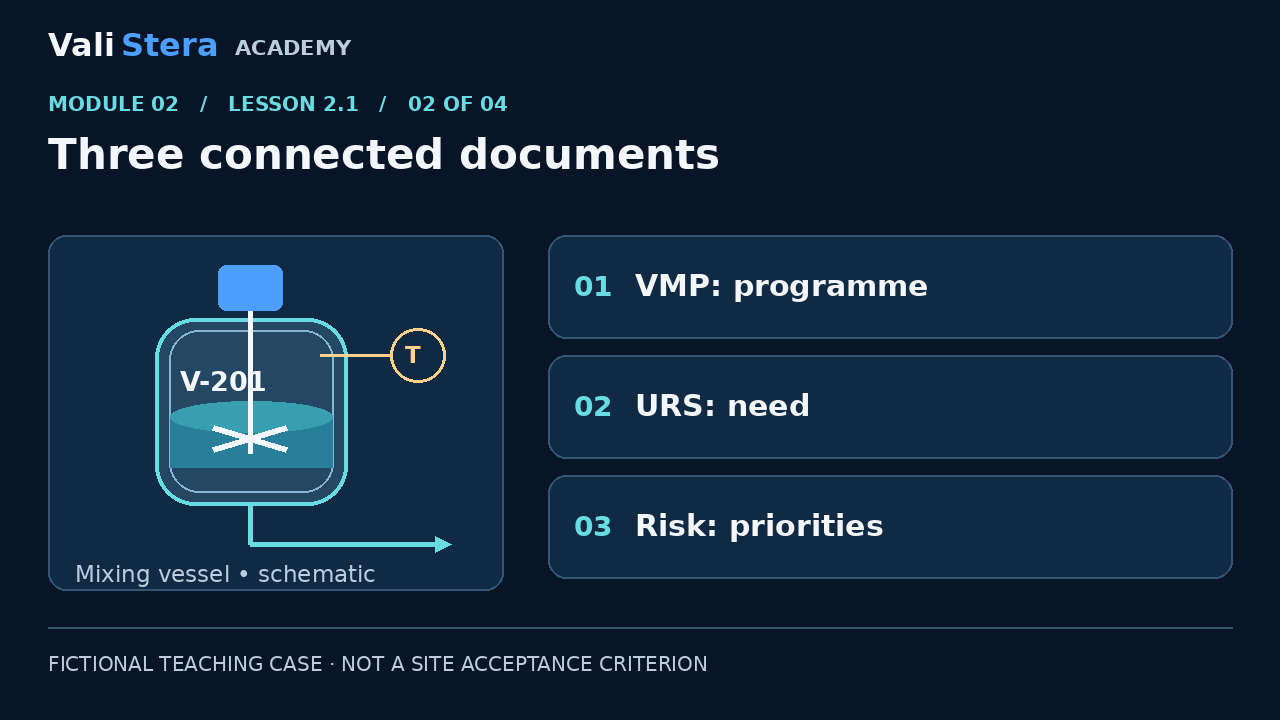
Three connected documents
View technical information · Diagram 2
Lesson explanation
The validation master plan describes the programme. The user requirements specification describes what the system must do. The risk assessment explains where failures matter and how controls will be justified. In this course we say VMP and URS. These documents should agree with one another. If the vessel needs controlled mixing, the requirement, risk discussion and verification evidence should all address that need.
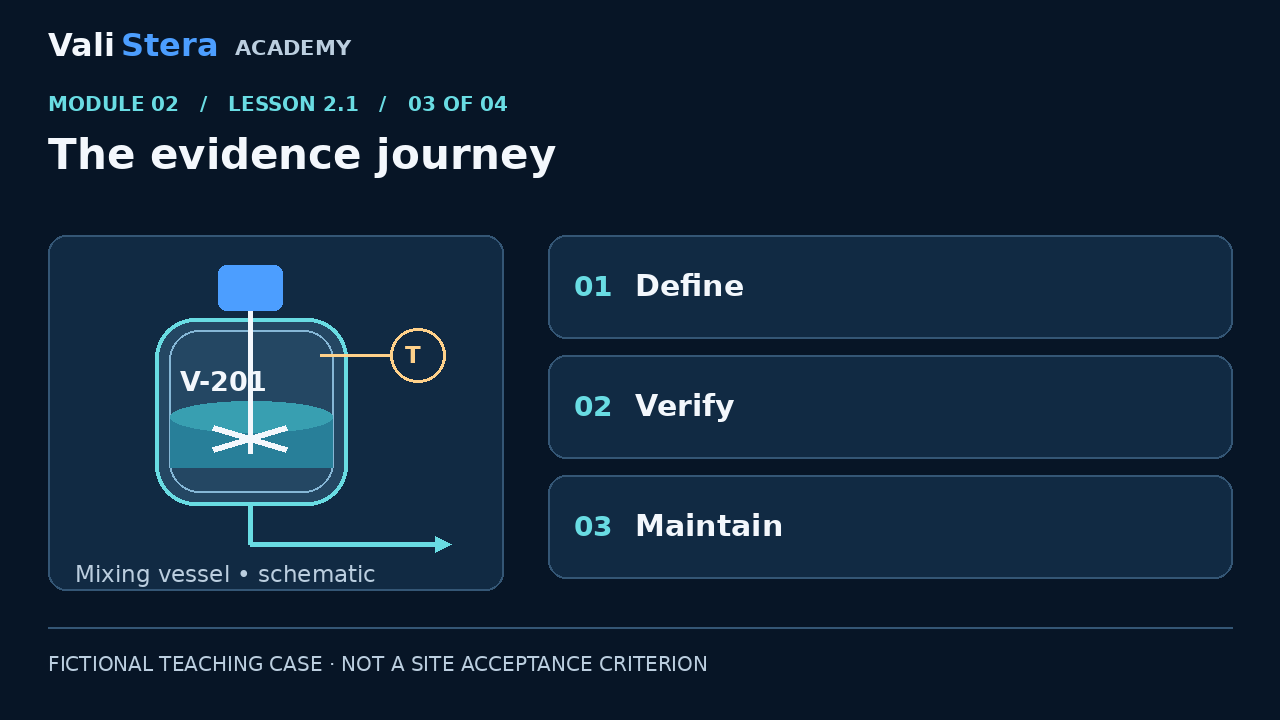
The evidence journey
View technical information · Diagram 3
Lesson explanation
Imagine buying a vessel because the catalogue says pharmaceutical grade. That description does not establish fitness for our product. The team still needs to understand contact materials, cleaning, measurement, mixing and records. The illustration connects a product vessel to its temperature sensor and control panel. These are functional interfaces, not a construction drawing. The same intended use must guide design review, testing and routine operation.
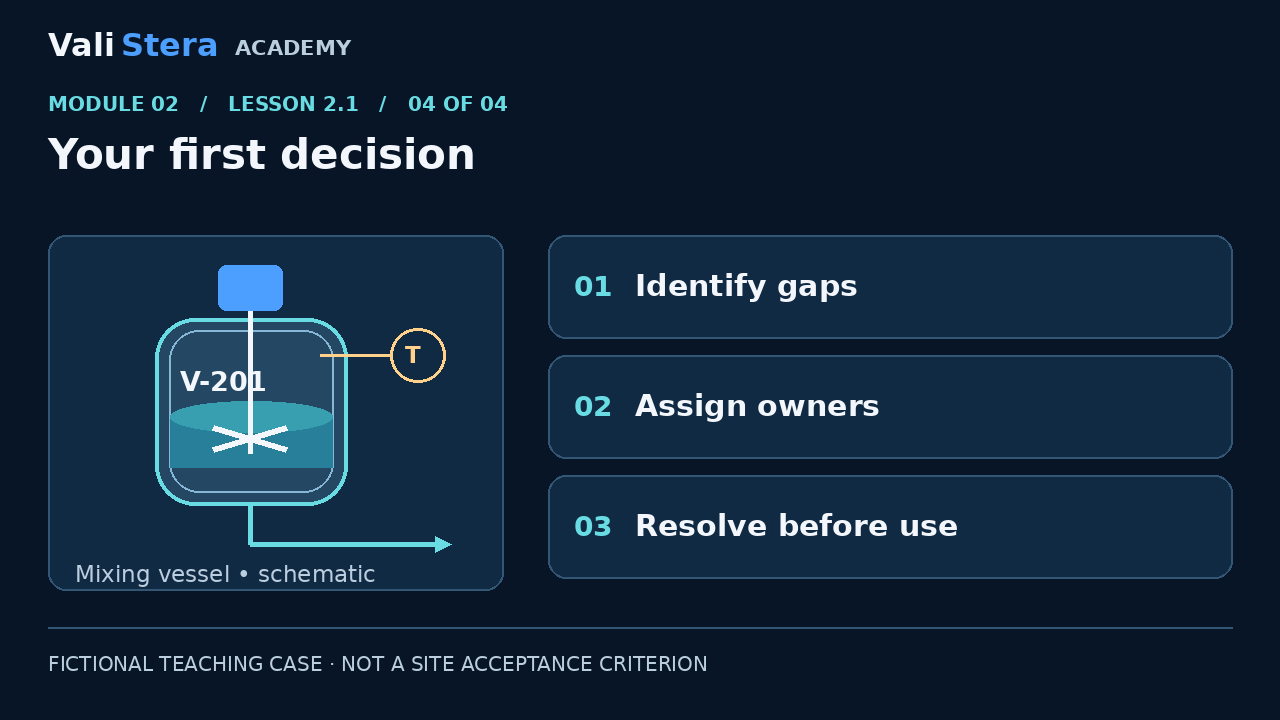
Your first decision
View technical information · Diagram 4
Lesson explanation
For the first activity, describe the vessel's intended use in three sentences. Identify the product family, operating purpose and important interfaces. Then list information that is still missing. Do not invent operating limits to complete a form. Assign each missing item to an appropriate owner, such as process development or engineering. Planning is useful when it exposes uncertainty early enough to change the project.
Apply it · Activity 1
Write a three-sentence intended-use statement and identify three unknowns.
Compare with model reasoning
Example: vessel V-201 prepares a defined aqueous oral-solution product family before transfer to filling. It mixes within the established batch-volume range and interfaces with approved utilities and a controlled transfer path. Confirm viscosity range, cleaning strategy and required measurement performance with their owners.