System boundaries and responsibilities
Identify interfaces and avoid gaps between teams.
2.0 minutes · English captions · Transcript + illustrated learning notes
This lesson has required companion reading below, including material not spoken in the video. Complete it before the assessment.
English captions available in the video player.
Narration and visual explanations
This transcript represents the recorded lesson using conventional written abbreviations and numerals. Open View technical information to see each diagram and its explanation. This lesson has required companion reading below, including material not spoken in the video. Complete it before the assessment.
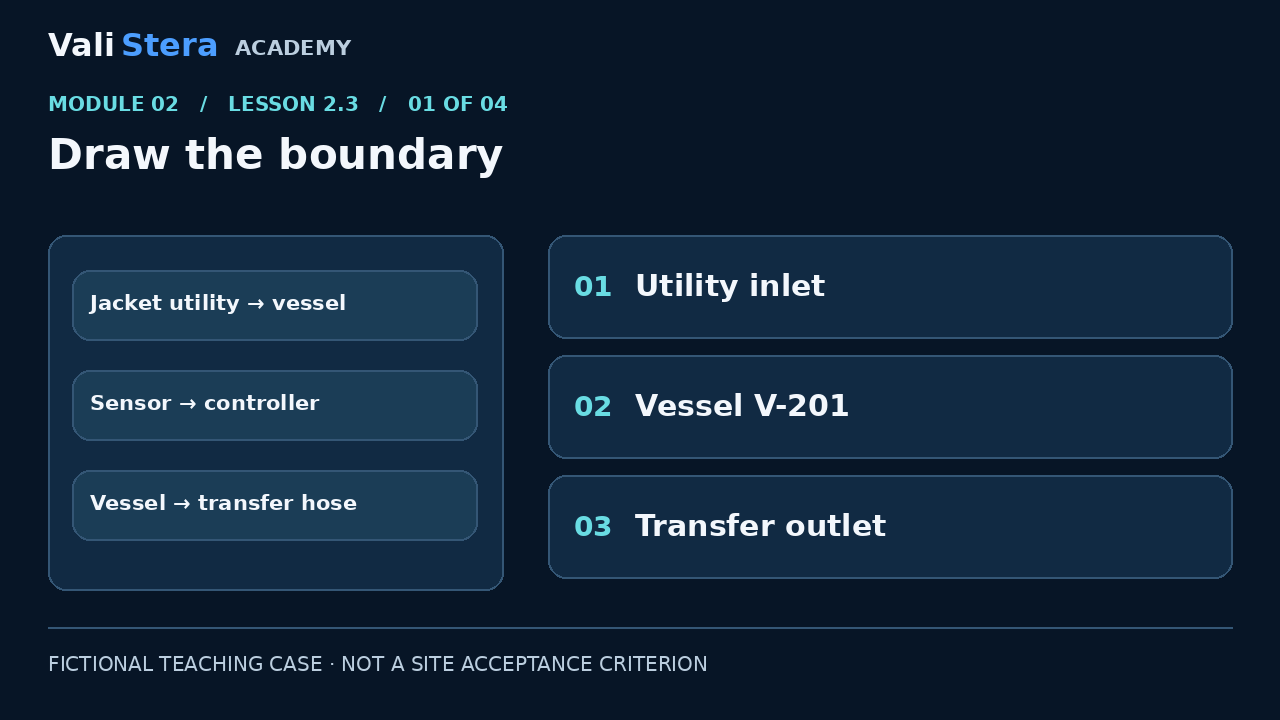
Draw the boundary
View technical information · Diagram 1
Lesson explanation
A system boundary is a practical agreement about what is included in the assessment. Our vessel receives product materials and a heating or cooling service, and transfers bulk solution downstream. The simplified diagram shows these interfaces. It does not assert that the utility is qualified by qualifying the vessel. Each interface needs an owner and a clear connection to the evidence for the supplying or receiving system.
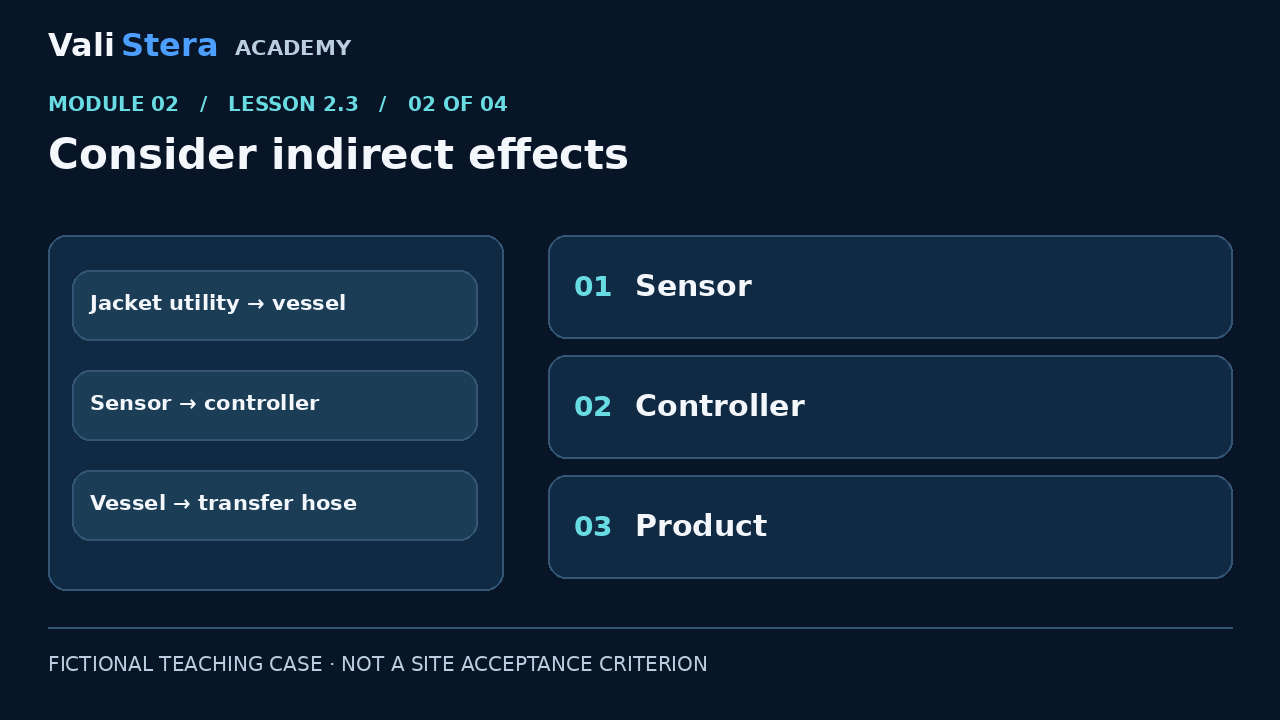
Consider indirect effects
View technical information · Diagram 2
Lesson explanation
A component does not need to touch product to affect quality. A temperature sensor sends information to a controller, which can influence the jacket service and therefore the product. Conversely, physical proximity alone does not make every room object equally important. Describe the mechanism by which a component failure could affect the process. Use that explanation to support scope decisions rather than relying only on a label such as critical.
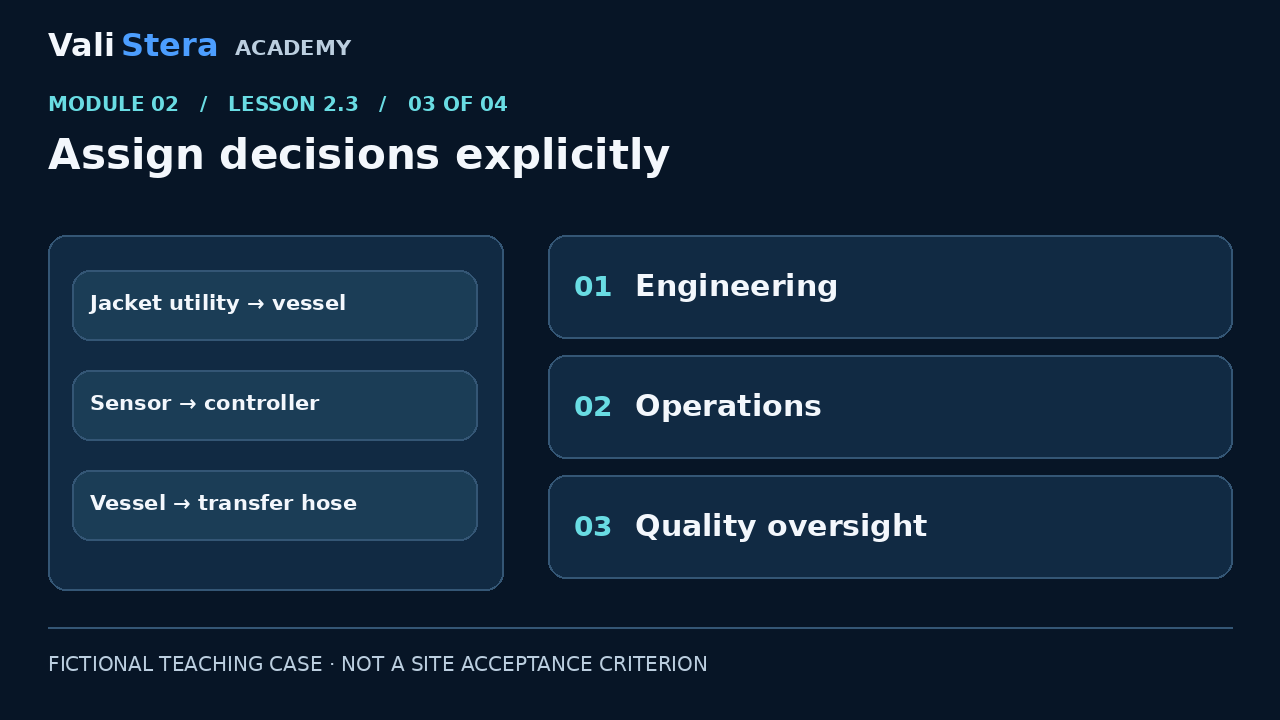
Assign decisions explicitly
View technical information · Diagram 3
Lesson explanation
Engineering understands the design and installation. Operations understands how people use and clean the equipment. Quality oversight connects decisions to the pharmaceutical quality system. Additional expertise may be needed from development, microbiology, metrology or information technology. This is a suggested team for the fictional project, not a universal organizational chart. Identify who prepares evidence, who reviews it and who has authority to approve each decision.
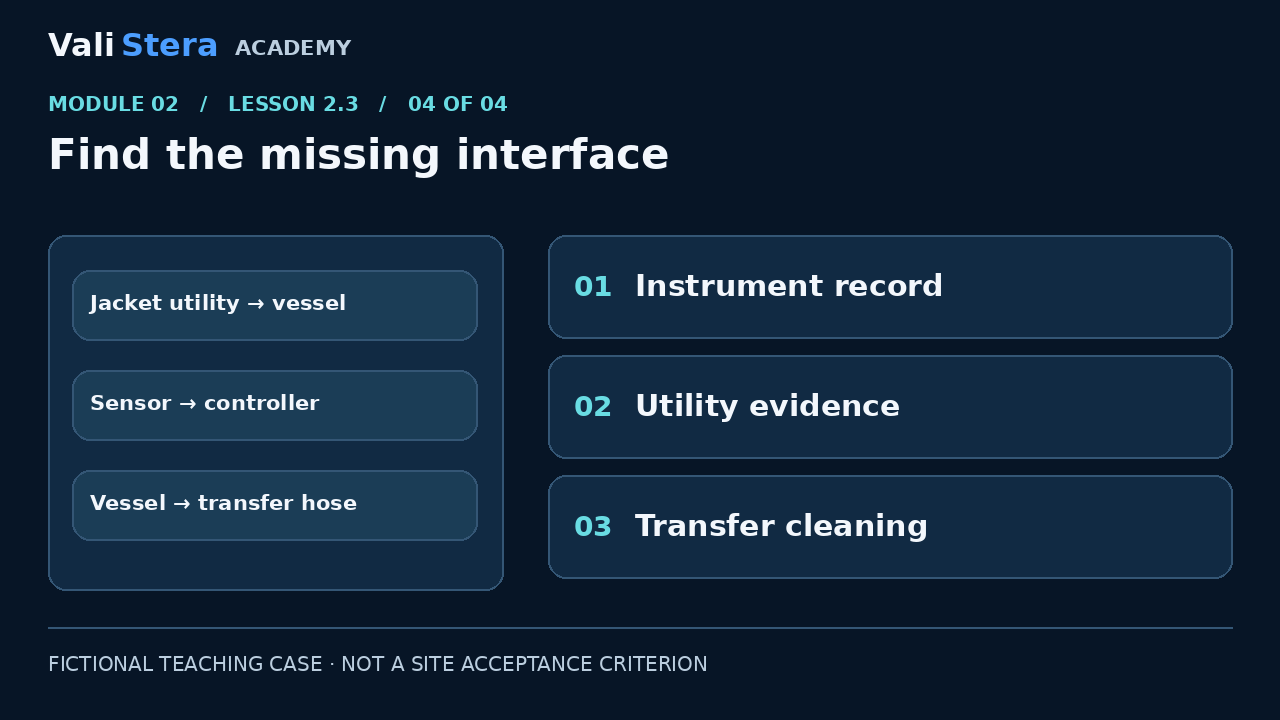
Find the missing interface
View technical information · Diagram 4
Lesson explanation
Review this handover: the vessel report is ready, but the transfer hose has no approved cleaning procedure and the utility connection is not identified. Calling the vessel ready for routine use would hide unresolved interfaces. Record the gaps and assess their impact. For the activity, draw a boundary and assign an owner to each interface. A boundary is useful only when work outside it has somewhere explicit to go.
Required reading: boundary and interface register
Worked teaching register for V-201. The vessel boundary does not eliminate interface dependencies. All references below are illustrative placeholders, not executed evidence.
| Interface | Owner | Evidence to request / open decision |
|---|---|---|
| Jacket utility to vessel | Engineering utilities | Utility qualification status and operating envelope; confirm that available supply supports intended temperature control. |
| Sensor to controller | Instrumentation | Sensor identification, calibration, control-loop design and fault-response challenge; do not infer independence from two displays. |
| Materials to product-contact surfaces | Production / Quality | Approved material suitability and contact compatibility records for the intended product family. |
| Vessel outlet to transfer hose | Production / Cleaning validation | Hose identity, cleaning verification and connection configuration; cleaning evidence remains open. |
Record each boundary, impact, document owner and outstanding action before assigning a qualification status.
Apply it · Activity 3
Draw four interfaces for V-201 and assign an owner and evidence reference to each.
Compare with model reasoning
Consider jacket utility supply, temperature measurement, incoming materials and transfer hose. Reference the relevant utility status, calibration evidence, material controls and cleaning verification. Flag missing evidence rather than assigning an assumed pass.