Build a useful validation master plan
Distinguish programme governance from a protocol and a schedule.
2.0 minutes · English captions · Transcript + illustrated learning notes
This lesson has required companion reading below, including material not spoken in the video. Complete it before the assessment.
Audio clarification: Recording clarification: the phrase “may be defined” is incomplete. Annex 15 §1.4 says the key programme elements should be documented in a VMP or equivalent document. Read the required VMP clarification below.
English captions available in the video player.
Narration and visual explanations
This transcript represents the recorded lesson using conventional written abbreviations and numerals. Open View technical information to see each diagram and its explanation. This lesson has required companion reading below, including material not spoken in the video. Complete it before the assessment.
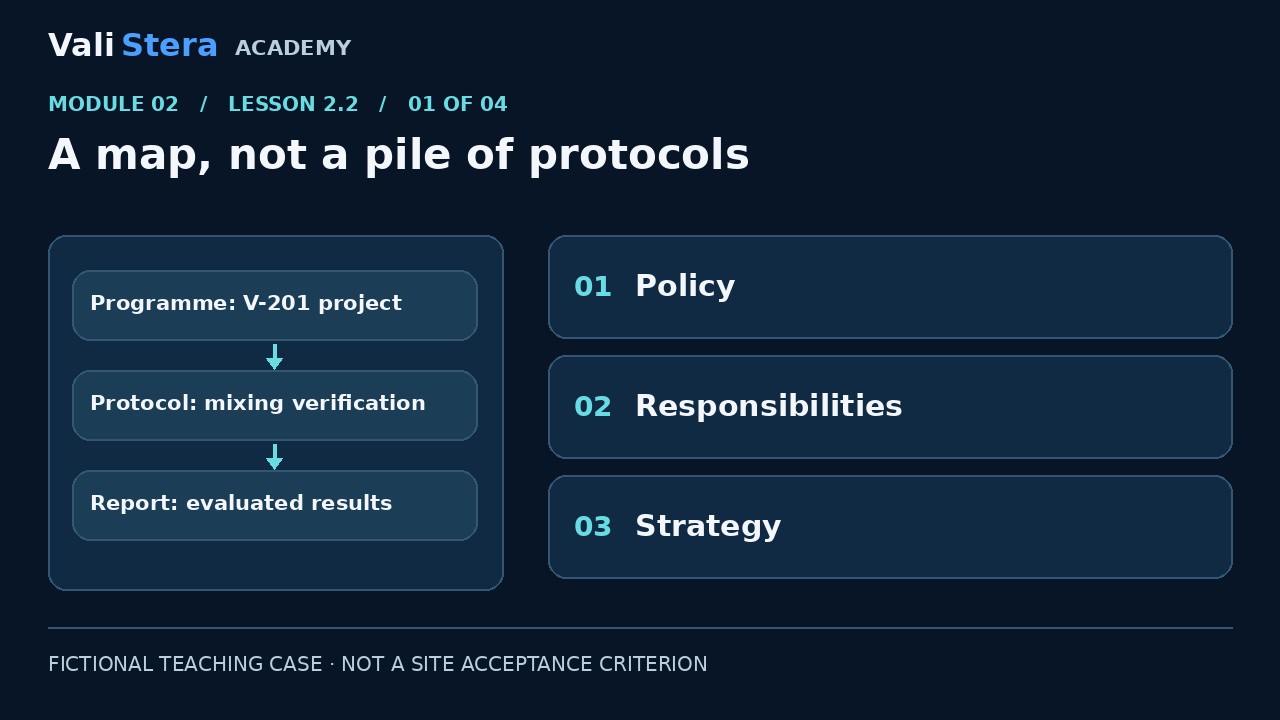
A map, not a pile of protocols
View technical information · Diagram 1
Lesson explanation
A useful validation master plan helps a new team member understand how qualification and validation are governed. In European Union GMP Annex 15, the programme may be defined in a VMP or equivalent document. This is not a requirement to give every site the same template. Our worked plan is a teaching structure. The applicable quality system determines the authorized document structure and approval responsibilities.
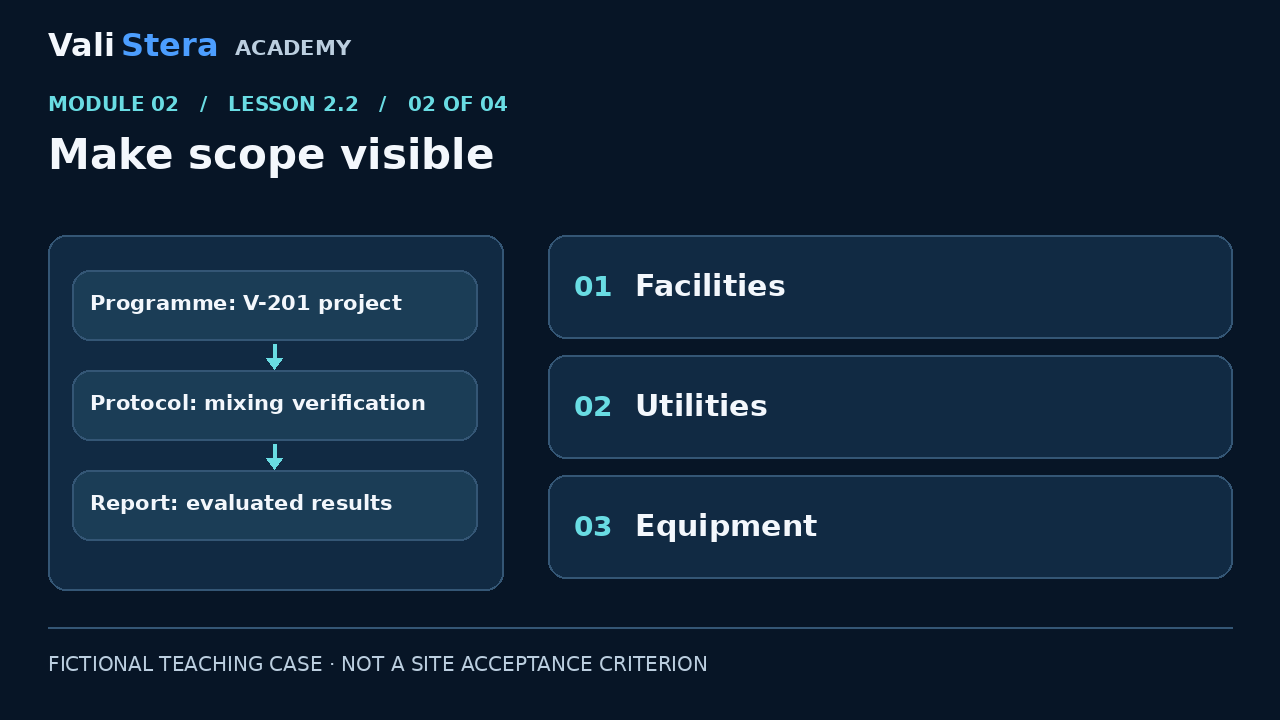
Make scope visible
View technical information · Diagram 2
Lesson explanation
For our small oral-liquid project, the plan links the mixing vessel, transfer equipment, utilities and supporting procedures. A scope table records the system identifier, intended use, responsible owner and current evidence status. An entry called complete without a report reference is difficult to challenge. An explicit status such as design review pending tells the team what still needs to happen. A date in a schedule is not proof of qualification.
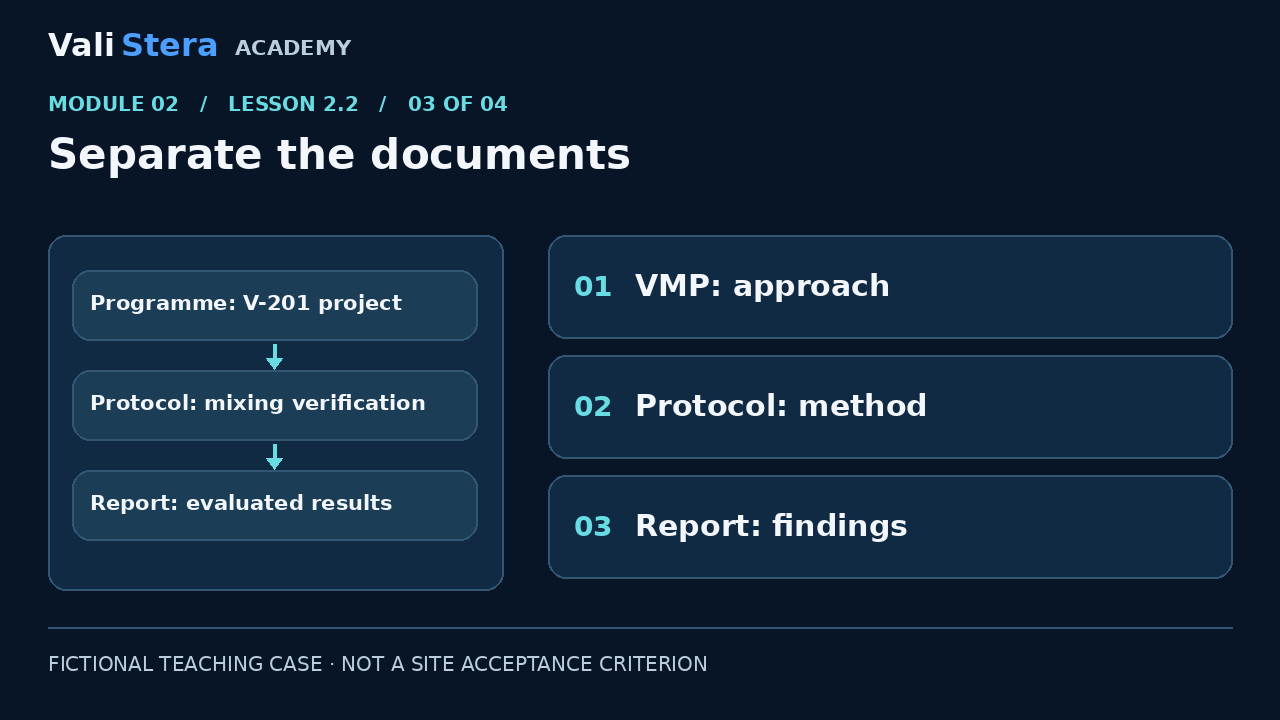
Separate the documents
View technical information · Diagram 3
Lesson explanation
The programme plan explains the approach and oversight. A protocol states how a particular verification will be performed and judged. A report evaluates what actually happened. The diagram presents these as connected documents rather than interchangeable files. For example, the plan may require risk-informed testing; the protocol specifies a particular mixing test; the report evaluates the observed results and any deviations.
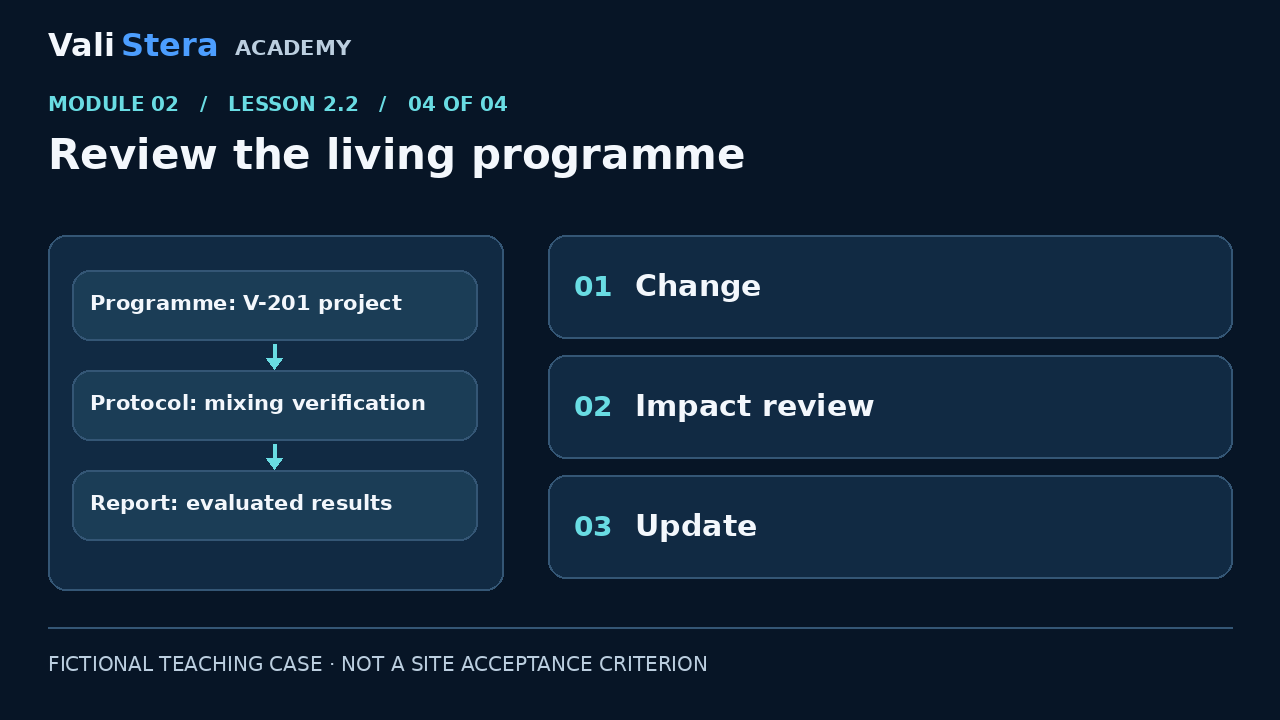
Review the living programme
View technical information · Diagram 4
Lesson explanation
Now suppose the project adds a second product with different cleaning needs. Reusing the original plan unchanged may conceal a new scope. Compare the new use with the approved assumptions, identify the affected systems, and route updates through the quality system. In the activity, prepare a short programme outline with owners, document references and review triggers. A useful plan should help people act, not merely describe intentions.
Required reading: VMP coverage
Annex 15 §1.4 says programme elements should be documented in a VMP or equivalent; the recorded phrase “may be defined” refers to the document choice, not an option to omit documentation.
Include policy, responsibilities, system/status summary, change and deviation handling, acceptance-criteria guidance, document references and strategy including applicable requalification (§1.5). Requalification evaluates continued control (§4).
Worked V-201 outline: policy—approved, risk-based qualification; owner—validation engineer with Quality oversight; status—DQ pending, installation not released; deviations—log and investigate failed criteria; changes—evaluate effects on URS and evidence; criteria—process owner provides scientific basis before approval; references—URS-V201, RA-V201, drawings; strategy—stage gates and periodic/change-triggered review of continued control. Each item needs an actual controlled reference in a real project.
Required reading: name the qualification stages
URS and/or functional specification → DQ → applicable FAT/SAT → IQ → OQ → PQ. This is a learning map, not a mandatory identical sequence for every project. Document justified combinations and applicability.
DQ verifies the URS against the design. FAT/SAT examine supplier/site acceptance. IQ checks installation; OQ checks operation and limits; PQ checks intended performance. Keep the URS as the lifecycle reference (Annex 15 §§3.1–3.14).
For V-201, trace URS-02 through design drawing DR-02, applicable factory checks, installed sensor identification, operational accuracy testing, and performance evidence under the intended load. A supplier pass alone does not close every stage.
Apply it · Activity 2
Draft a one-page programme outline with scope, ownership, document hierarchy and three review triggers.
Compare with model reasoning
Include the project purpose, V-201 and its interfaces, engineering and quality responsibilities, links to requirements and protocols, deviation/change routes, status reporting and review after product change, significant modification or adverse performance.