Turn risk controls into testable actions
Connect proposed controls to owners and evidence.
2.0 minutes · English captions · Transcript + illustrated learning notes
This lesson has required companion reading below, including material not spoken in the video. Complete it before the assessment.
English captions available in the video player.
Narration and visual explanations
This transcript represents the recorded lesson using conventional written abbreviations and numerals. Open View technical information to see each diagram and its explanation. This lesson has required companion reading below, including material not spoken in the video. Complete it before the assessment.
Prefer a clear mechanism
View technical information · Diagram 1
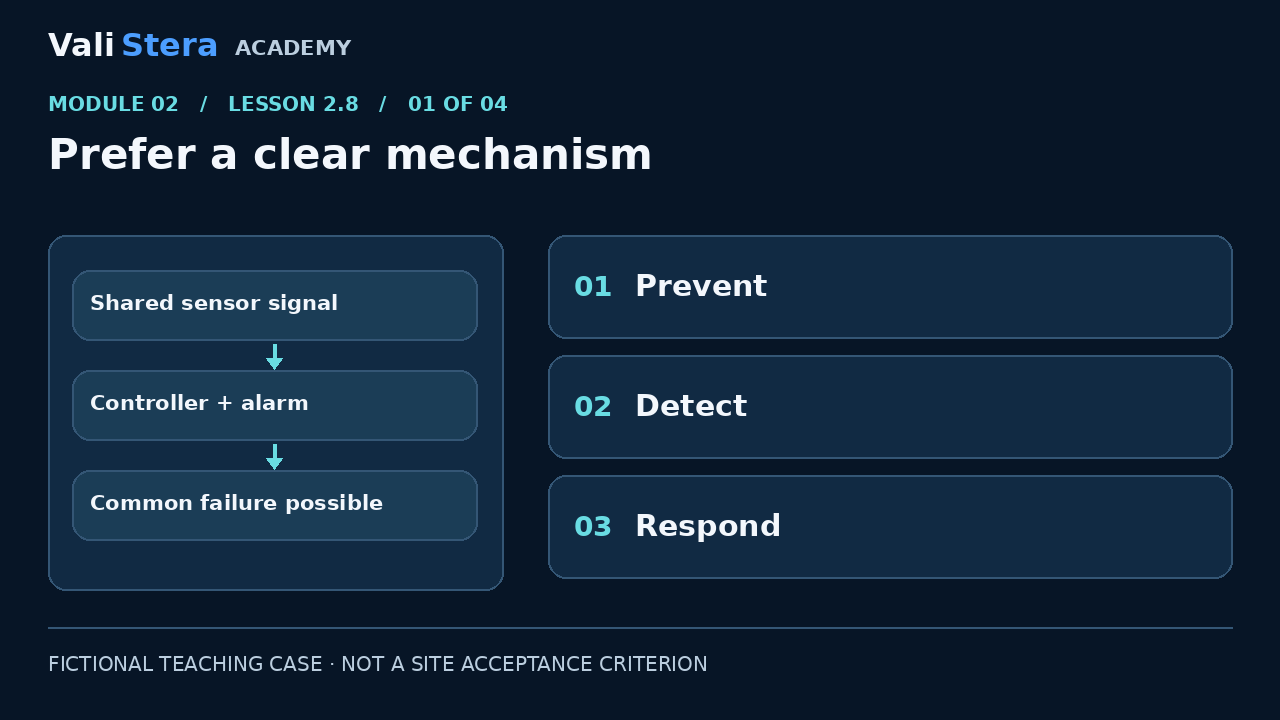
Lesson explanation
A control should explain how it changes the failure pathway. Prevention reduces the chance of failure. Detection identifies a problem. Response determines what happens next. For a mixing failure, a justified design or operating control may prevent an unsuitable condition. An alarm may detect it, but only an effective response can limit the consequence. The three blocks are complementary; none is automatically adequate for every process.
Assign an owner and proof
View technical information · Diagram 2
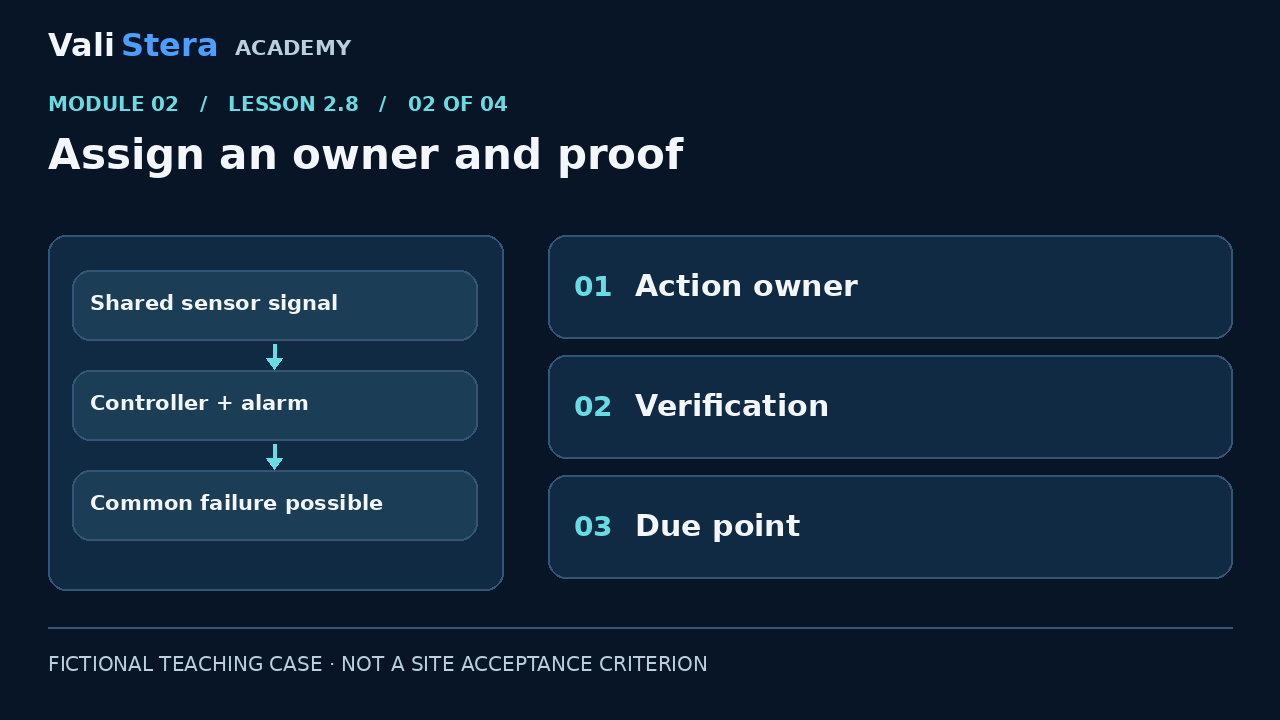
Lesson explanation
Our fictional action is to verify the agitator-status indication and the defined response to loss of mixing. Engineering owns the technical check and operations owns the response procedure and training. The verification plan records the challenge method and the expected behaviour. Quality oversight reviews the evidence through the site system. Action closed should mean the intended result was demonstrated, not merely that a document was drafted.
Look for new failure paths
View technical information · Diagram 3
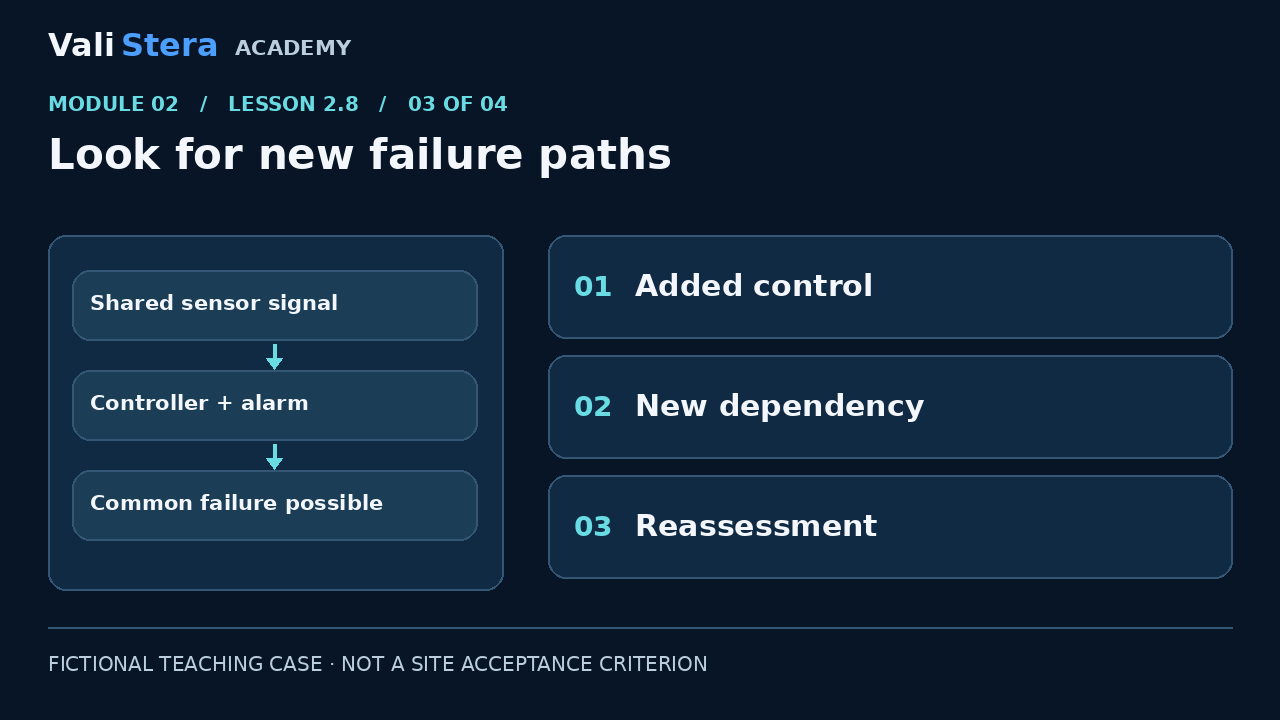
Lesson explanation
Adding a control can introduce a new dependency. An alarm may depend on power, configuration, sensor health or a shared signal. If the alarm and controller use the same failed sensor, apparent independence may be misleading. The diagram shows a common sensor feeding two functions to make that concern visible. Examine the actual architecture and challenge assumptions before taking credit for an independent protective layer.
Residual risk is a decision
View technical information · Diagram 4
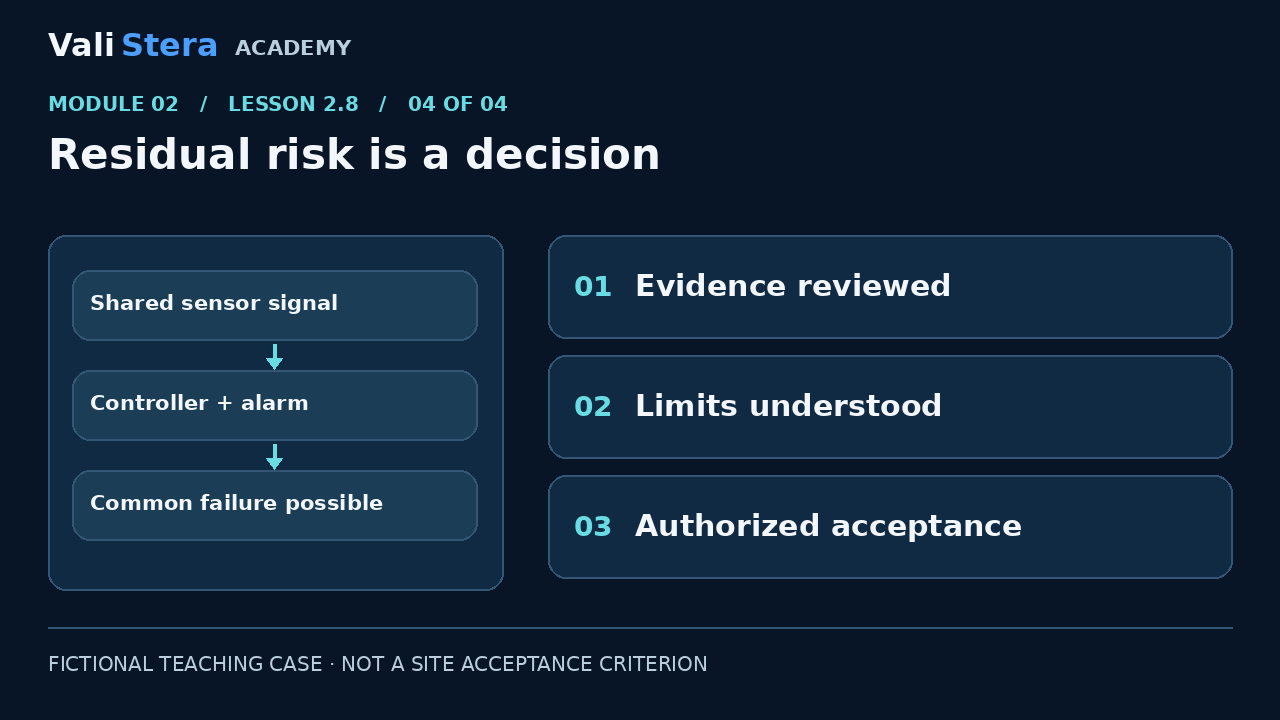
Lesson explanation
After controls are implemented, evaluate what risk remains and who can accept it. Record assumptions and review triggers. Quality risk management does not excuse a practice that conflicts with applicable requirements. For the activity, select one failure mode and propose a prevention, detection and response strategy. Then identify evidence for effectiveness and one new risk introduced by your proposal. This turns a list of actions into an auditable argument.
Required reading: a worked control plan
Illustrative scenario: V-201 agitation stops during preparation. A shared speed sensor can undermine both control and alarm functions, so independent protection must be demonstrated, not assumed.
| Control-plan field | Worked teaching entry |
|---|---|
| Risk and objective | Unnoticed loss of agitation could cause non-uniform concentration; prevent transfer until the consequence is assessed. |
| Proposed prevention / detection | Engineering evaluates drive reliability and an independently challenged low-speed signal; automatic transfer inhibition is proposed, not installed or verified. |
| Owner and due point | Engineering designs the control before OQ; validation prepares the fault challenge; production defines the batch-hold response; Quality reviews risk. |
| Verification and evidence | Approved OQ challenge of sensor failure, stopped drive, alarm annunciation and transfer inhibition; retain raw results, deviations and approved report. |
| Residual risk and trigger | Pending demonstrated effectiveness. Reassess after control-logic changes, a missed alarm, a drive trip or a new product; do not lower severity without rationale. |
Compare a shared-sensor alarm with a genuinely independent detection path. The number of controls is not proof of independence or effectiveness.
Apply it · Activity 8
Write one control plan with an owner, verification method, completion evidence and review trigger.
Compare with model reasoning
For loss of mixing, consider suitable design/operating controls, status detection and a defined product-impact response. Verify the signal, alarm and response assumptions; assess common-cause failures and document residual risk.