Build a controlled design-review baseline
Identify the requirements, specifications and revisions that define the review.
2.0 minutes · English captions · Illustrations and worked example
This lesson’s core explanations and worked-example reasoning are narrated. The table restates the example for reference; the practice activity and model answer are reading exercises.
English captions available.
Narration and visual explanations
Open View Technical Explanation to see each diagram, its text description and the matching narration. Standard abbreviations and numerals are used visually.
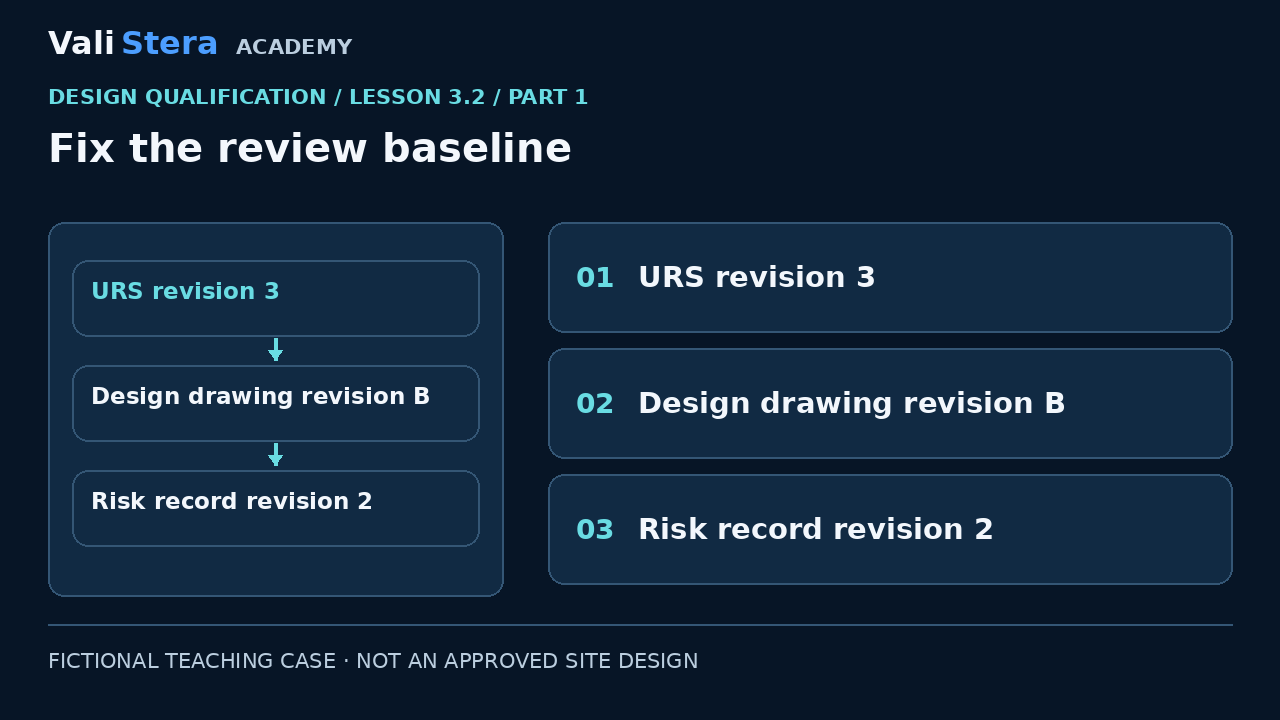
Fix the review baseline
View Technical Explanation · Diagram 1
Lesson explanation
For the fictional review, use a user requirements specification, or URS, at revision three, drawing revision B and risk record revision two. These references are teaching placeholders. A baseline is the defined set of information used for the review. If one reviewer reads revision A while another reads revision B, apparent agreement may hide a different design. Record the document identifiers, revisions and approval status together.
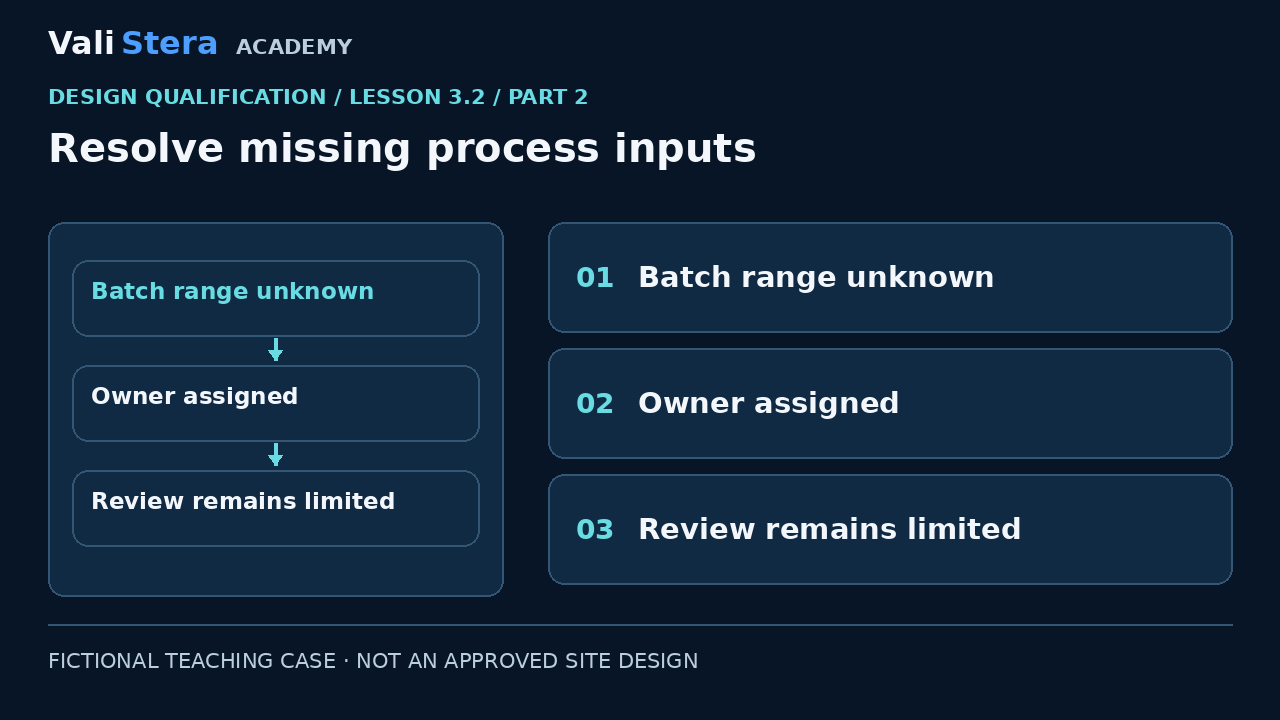
Resolve missing process inputs
View Technical Explanation · Diagram 2
Lesson explanation
Suppose the process team has not defined the batch-volume range. The supplier offers a vessel capacity, but a catalogue capacity is not an agreed process need. Raise a question to the process owner and record the consequence for impeller location and mixing verification. The design review may examine unrelated matters, but it cannot conclude that mixing is suitable across an unspecified range. Unknown inputs should stay visible.
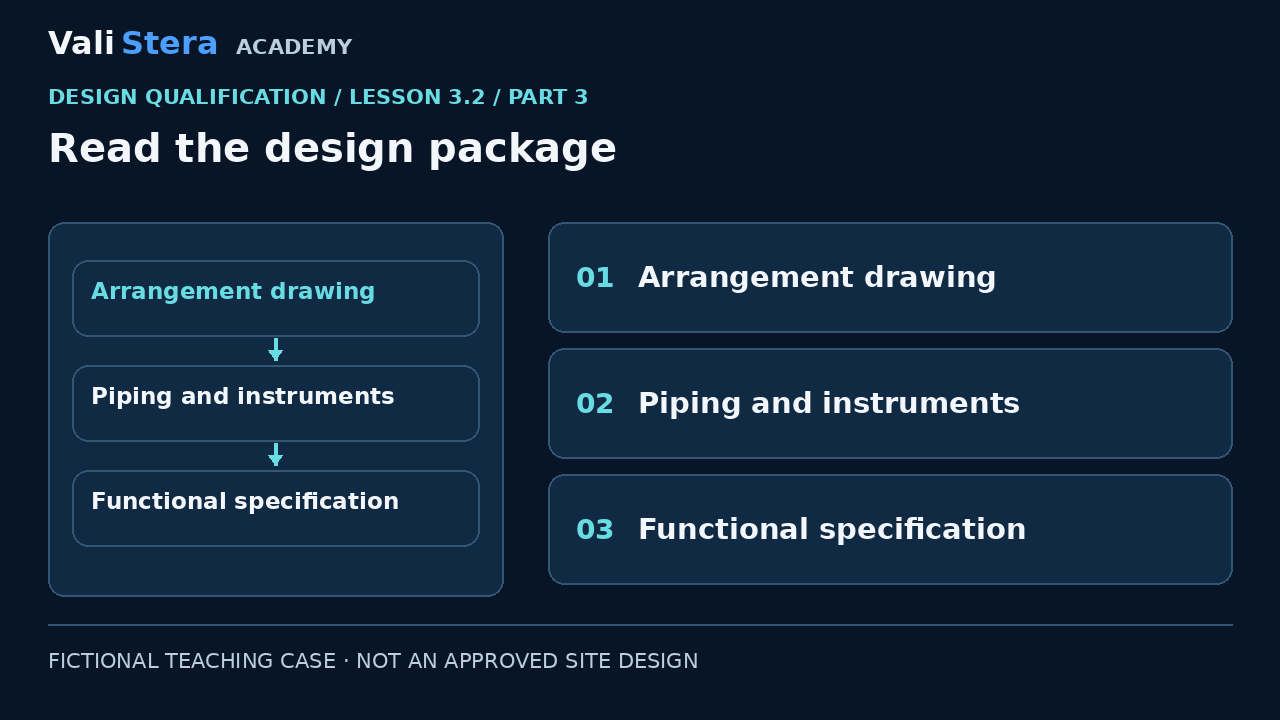
Read the design package
View Technical Explanation · Diagram 3
Lesson explanation
An arrangement drawing shows physical placement. A piping and instrumentation diagram shows process connections and instruments. A functional specification describes intended control behaviour. Our teaching package also includes material specifications, a cleaning concept and an interface register. These documents answer different questions. A drawing label such as temperature control does not describe alarm delays, sensor failure responses or operator permissions. Request the document that actually supports the claim.
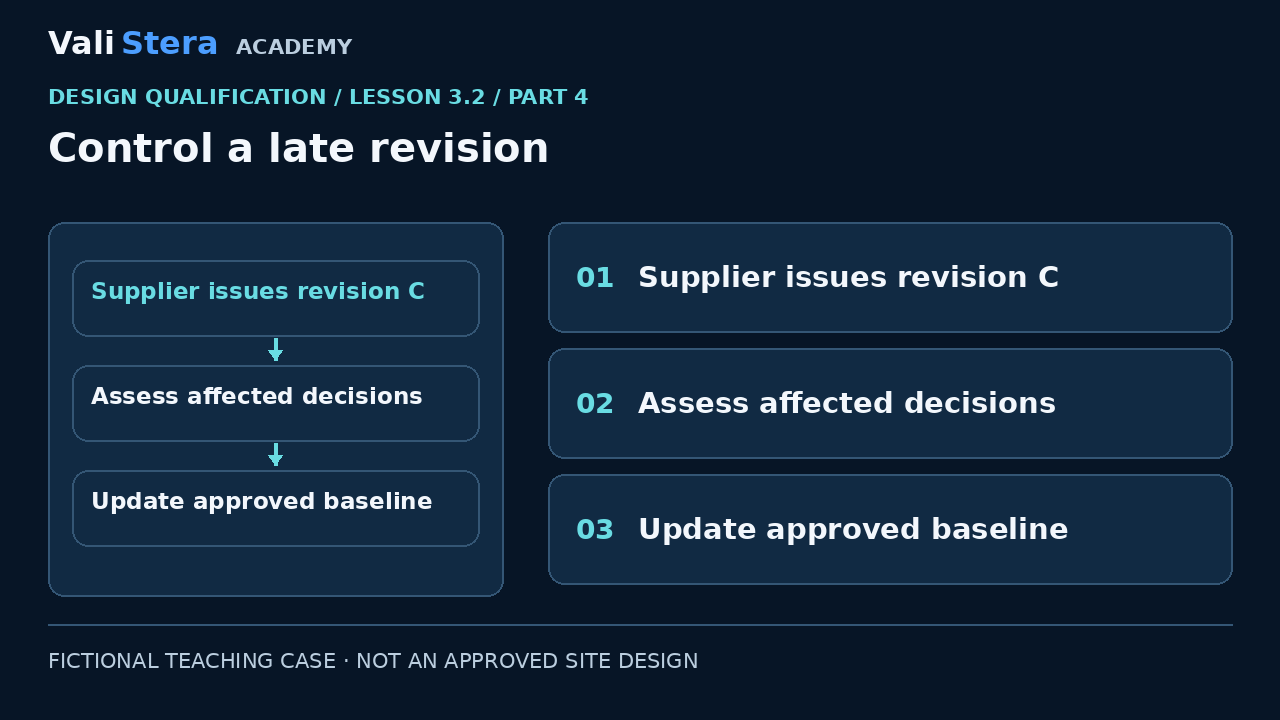
Control a late revision
View Technical Explanation · Diagram 4
Lesson explanation
During review, the supplier issues revision C with a different outlet valve. Do not silently replace the drawing and keep the old signatures. Compare the change, identify affected requirements and risks, and obtain the appropriate review. Record which conclusions remain applicable and which need reassessment. The goal is not to restart every check automatically, but to prevent an unreviewed design from inheriting an earlier conclusion.
Worked example
| Document | Teaching baseline | Review consequence |
|---|---|---|
| URS | URS-V201 revision 3, teaching baseline | Defines needs; unresolved batch range remains a gap |
| Drawing | GA-V201 revision B | Physical design under review |
| Control description | FS-V201 revision 1 | Defines intended control/fault response |
| Supplier update | GA-V201 revision C, not yet accepted | Outlet change requires impact assessment |
Apply it · Activity 2
Prepare a baseline register containing five documents, revision/status, owner and one unresolved question.
Open workbook activityCompare with model reasoning
Include URS, arrangement drawing, piping/instrument diagram, functional specification and risk record. Mark missing or draft inputs explicitly; assign the batch-range question to the process owner and identify affected mixing conclusions.