Review contact materials and cleanability
Connect product-contact design to evidence without assuming a universal material specification.
2.1 minutes · English captions · Illustrations and worked example
This lesson’s core explanations and worked-example reasoning are narrated. The table restates the example for reference; the practice activity and model answer are reading exercises.
English captions available.
Narration and visual explanations
Open View Technical Explanation to see each diagram, its text description and the matching narration. Standard abbreviations and numerals are used visually.
Follow the complete contact path
View Technical Explanation · Diagram 1
Lesson explanation
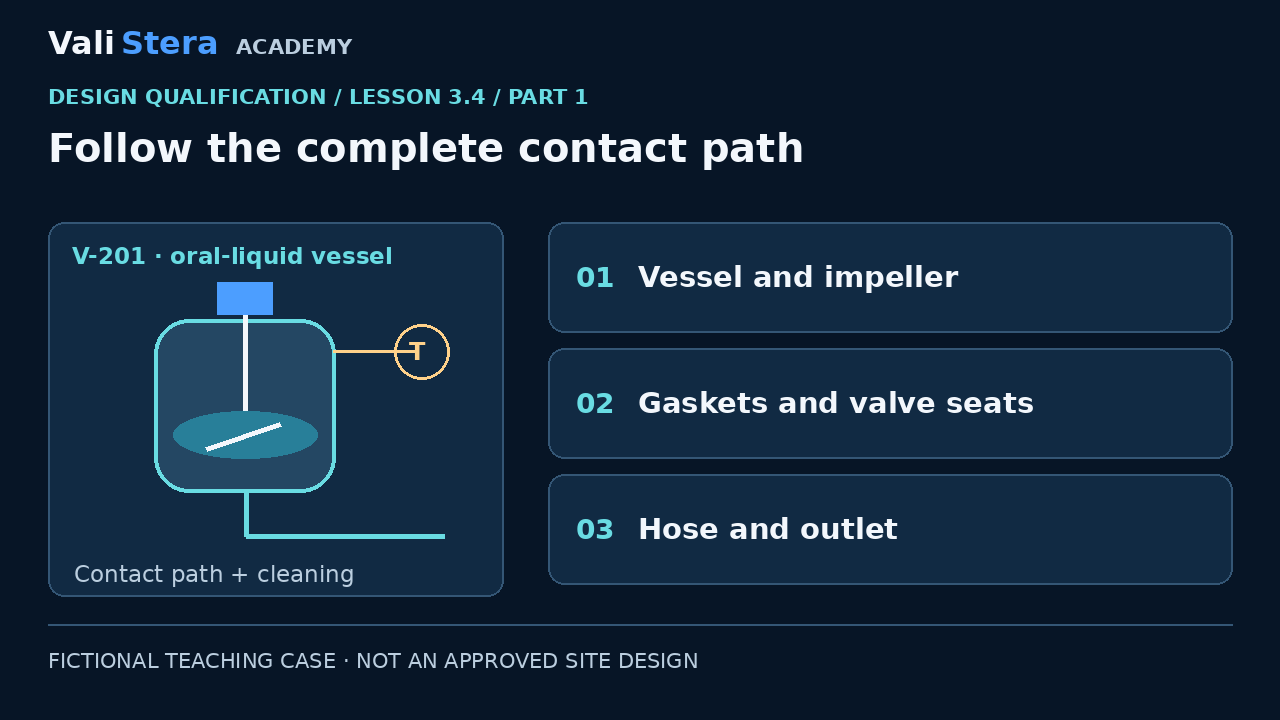
Trace the liquid from the vessel through the outlet and transfer hose. Include impeller surfaces, seals, gaskets and valve seats, not just the vessel shell. The diagram marks these as one contact path. A statement that the vessel is stainless steel leaves elastomers and purchased components unresolved. Ask how each material is identified and justified for the product, cleaning agents, temperature and contact time relevant to the intended use.
Separate grade from suitability
View Technical Explanation · Diagram 2
Lesson explanation
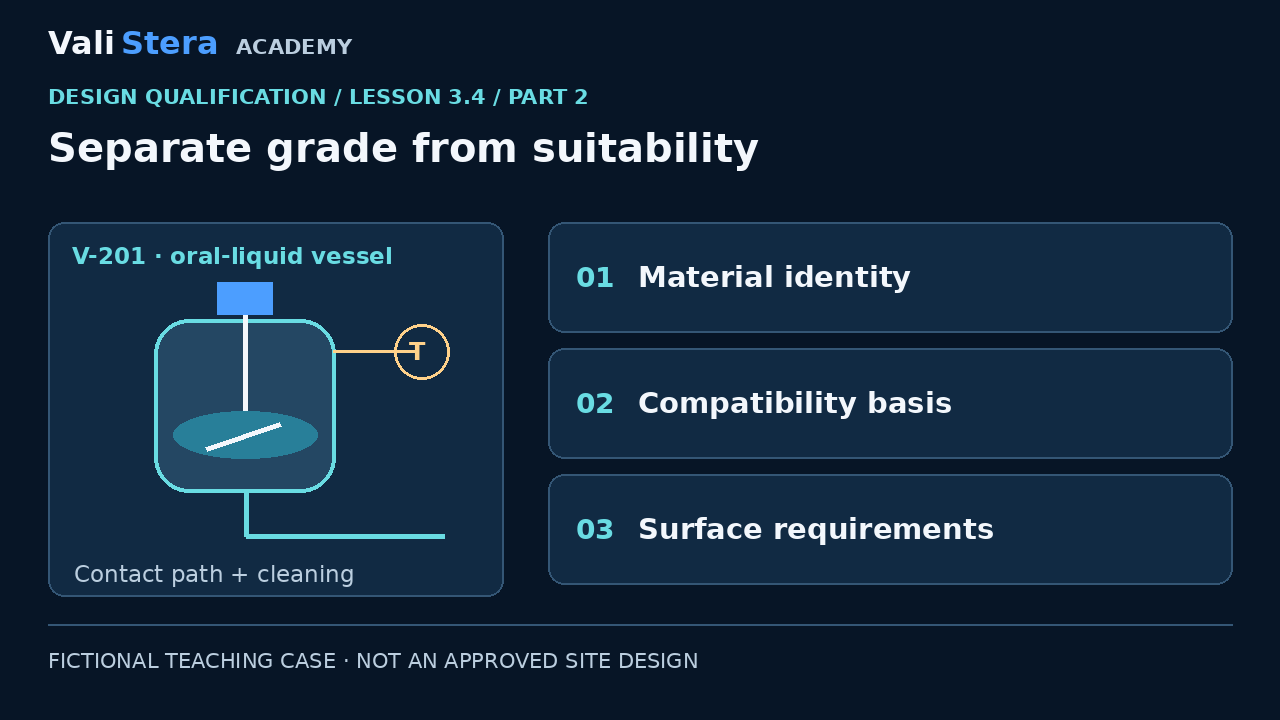
A material certificate can support identity, but identity alone does not prove compatibility with a specific formulation or cleaning regime. Similarly, a surface-finish number is useful only with a justified requirement and a defined verification method. This introductory module does not prescribe a universal steel grade, roughness value or elastomer. In the fictional review, mark the gasket compatibility statement missing and request product-specific evidence from the responsible specialists.
Make cleaning possible
View Technical Explanation · Diagram 3
Lesson explanation
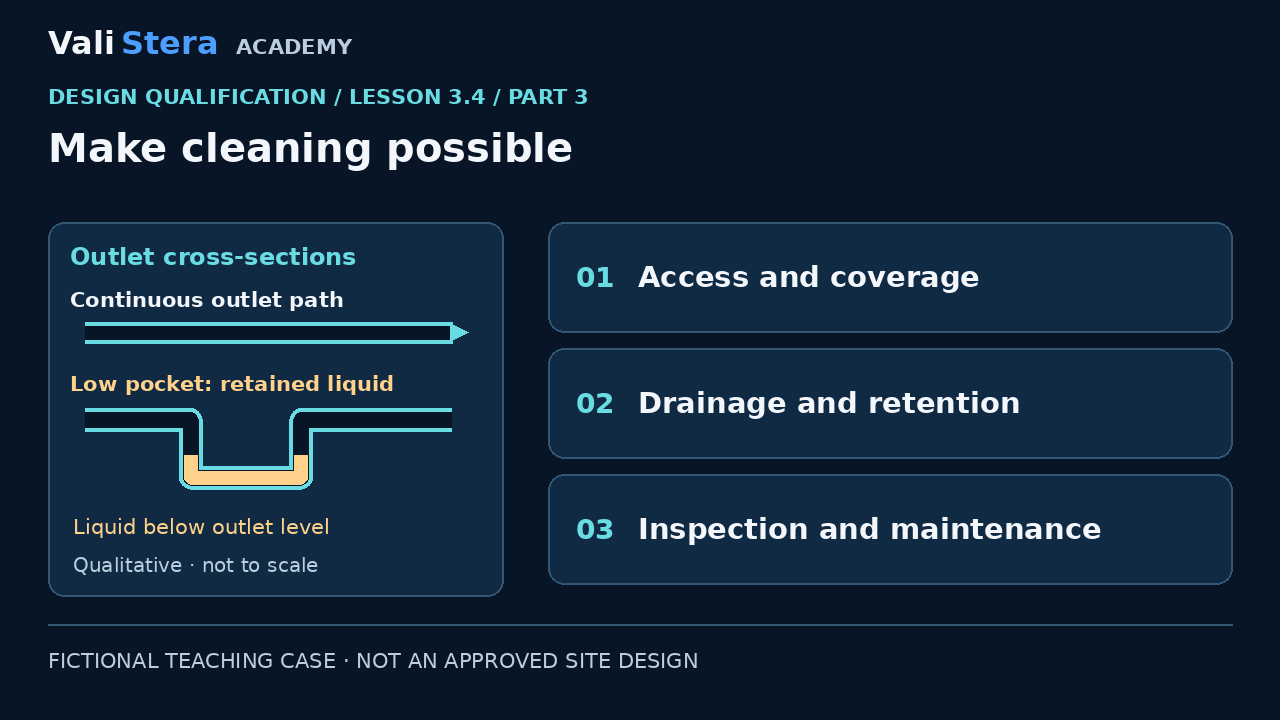
The design sketch contrasts a clear outlet path with a pocket that may retain liquid. Review access, cleaning coverage, disassembly needs, drainage and inspection. Consider whether maintenance can be performed without creating an uncontrolled product-quality risk. A favourable drawing is only a design argument: cleaning effectiveness still needs the applicable validation evidence. Do not copy a hygienic-design ratio from another application and present it as a universal GMP rule.
Turn a concern into an action
View Technical Explanation · Diagram 4
Lesson explanation
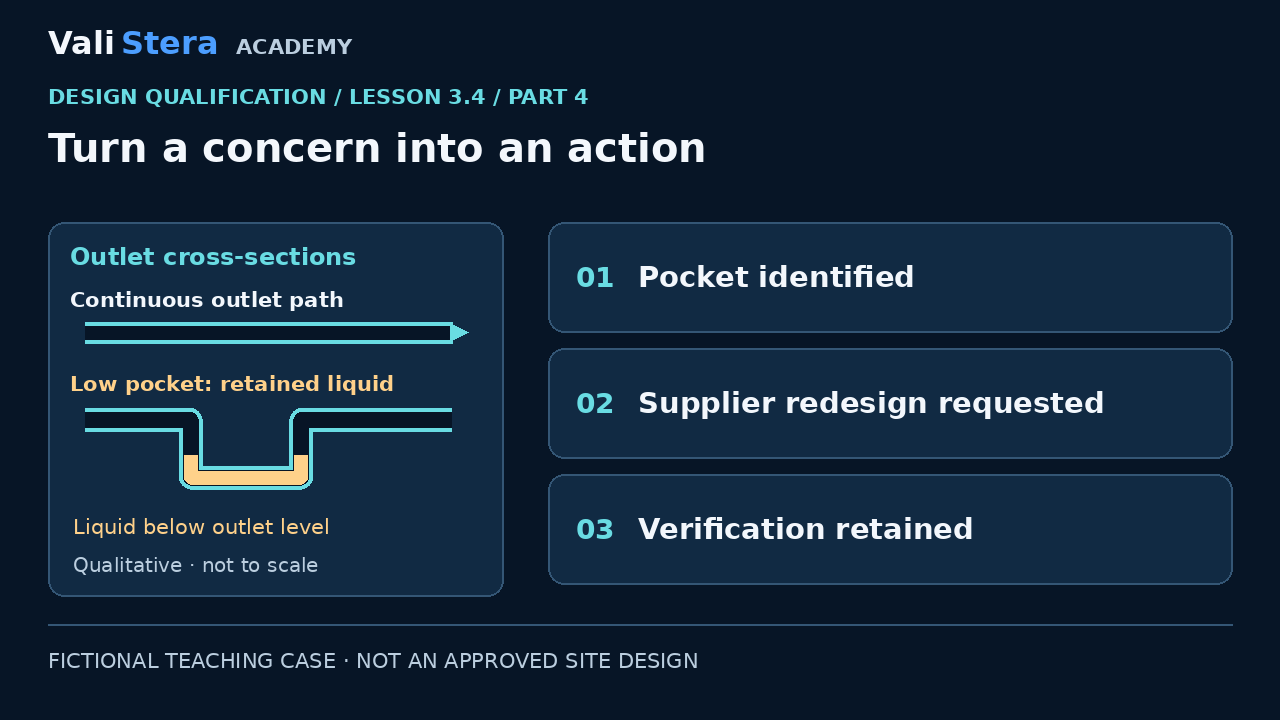
Our worked finding is specific: the outlet drawing shows a retained pocket with no cleaning rationale. Record the drawing revision and location, request a revised arrangement or a justified control strategy, and assign an owner. Link the response to installation inspection and the cleaning study. Avoid a vague action such as improve cleanability. A closed action needs reviewed evidence that addresses the actual concern, not merely an email saying resolved.
Worked example
| Design concern | Evidence/action | Later verification |
|---|---|---|
| Gasket unspecified | Identify material and compatibility basis | Confirm installed identity and approved maintenance replacement |
| Outlet pocket | Review drawing, cleaning concept and redesign/rationale | Inspect installed geometry; evaluate cleaning effectiveness |
| Surface requirement absent | Define justified requirement and method | Verify against the approved basis |
Apply it · Activity 4
Write a design finding for an outlet pocket and a separate question for an unspecified gasket.
Open workbook activityCompare with model reasoning
Reference the drawing and contact-component list. Request cleaning/drainage rationale or redesign for the pocket, and compatibility evidence for the gasket. Assign engineering/cleaning and materials specialists; retain later verification.